Ring Size Guide: How to Measure at Home, With a US, UK and EU Chart
Find your ring size at home with a string or an existing ring, then convert between US, UK and EU sizes with our chart. Plus tips for wide bands and…


Two necklaces can look identical in a product photo and still be completely different things. One is gold all the way through. The other is a thin coat of gold over brass that will start to show its true color within months. The words on the label are what separate them, and they are easy to blur together: solid, filled, plated, vermeil.
Here is what each one actually means, how long it lasts, and how to tell them apart before you buy.
Gold plating is made by electrically bonding a very thin layer of gold onto a base metal, usually brass or copper. The layer is measured in microns, often less than one. It looks right on day one, which is why plated jewelry photographs so well.
The problem is friction. Plating wears away exactly where a piece is touched or rubbed most: the clasp, the back of a pendant, the inside of a ring, the edge of a nameplate. Once the base metal shows through, it can only be re-plated, never repaired. Plated jewelry can also tarnish or turn skin green as the metal underneath reacts with sweat.
Vermeil (pronounced ver-may) is gold plating over sterling silver, usually with a thicker layer than standard plating. It is a step up because the base metal is precious and less likely to cause skin reactions. But it is still a layer, and it still wears through with daily wear. Underneath, you are wearing silver.
Gold filled jewelry is made by bonding a sheet of gold to a base metal core with heat and pressure. In the United States, gold filled items must contain at least 1/20 gold by weight, so the gold layer is far thicker than plating. It lasts years rather than months.
It is still a layer, though. Gold filled pieces cannot be resized, soldered or repaired the way solid gold can, and once the gold wears thin at a stress point, the brass core appears.
Solid gold jewelry is made from a gold alloy through its entire body. There is no coating and nothing underneath. A solid 14K gold piece is stamped 585, the international hallmark for 14 karat gold, and that composition is the same at the surface as it is at the core.
That has practical consequences:
 North Star Necklace
View North Star Necklace on Etsy
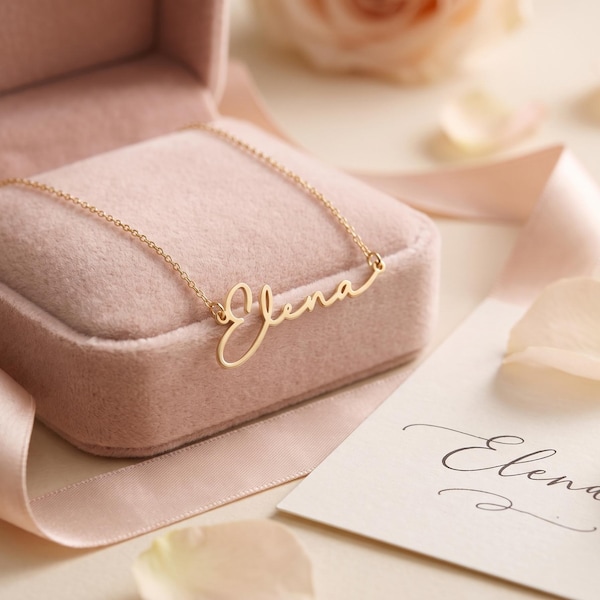 Cursive Name Necklace
View Cursive Name Necklace on Etsy
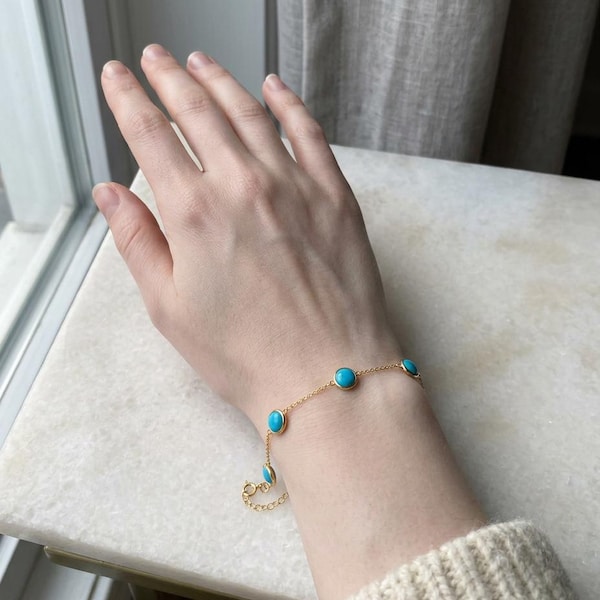 Turquoise Station Bracelet
View Turquoise Station Bracelet on Etsy
| Gold plated | Vermeil | Gold filled | Solid 14K gold | |
|---|---|---|---|---|
| What it is | Thin gold coat on brass or copper | Gold coat on sterling silver | Gold sheet bonded to a brass core | Gold alloy all the way through |
| Typical lifespan | Months | Months to a few years | Years | Generations |
| Can be repaired or resized | No | Rarely | Rarely | Yes |
| Can tarnish | Yes | Yes | Over time | No |
| Hallmark | Often GP or none | 925 plus vermeil | GF or 1/20 | 585 (14K) |
Some jewelry is solid gold but hollow inside. Hollow chains and hoops are lighter and cheaper because there is less gold in them, but they dent easily and are hard to repair. If a heavy-looking piece is surprisingly inexpensive, ask whether it is hollow. Every piece we make is solid, not semi-hollow.
Solid gold costs more on day one. Over the years you wear it, it is usually the cheaper choice.
Every piece from our Grand Bazaar atelier is solid 14K gold, stamped 585. Not plated, not filled, not vermeil and not semi-hollow. It is the reason our prices are not the lowest you will find, and we would rather say that plainly.
Yes. Gold filled jewelry has a much thicker layer of gold, bonded with heat and pressure, so it lasts years rather than months. It is still a layer over brass, though, so it cannot be resized or repaired like solid gold.
No. Solid 14K and 18K gold do not tarnish or turn green. If solid gold looks dull, it is usually a film of soap or lotion that washes off with warm soapy water.
Vermeil is real gold plated over sterling silver. The gold layer is thicker than standard plating, but it is still a coating that wears through with daily wear.
Look for a karat stamp such as 585 or 14K, and no GP, GF, HGE or 925 markings. If you are unsure, a jeweler can test it in a few minutes.
For pieces you wear every day, usually yes. Plated jewelry often needs replacing within a year or two, while solid gold can be worn for decades, repaired when needed and keeps its metal value.
Share:
Find your ring size at home with a string or an existing ring, then convert between US, UK and EU sizes with our chart. Plus tips for wide bands and…
Diamond vs cubic zirconia: how hardness, brilliance, fire and care compare, simple ways to tell them apart, and why honest labeling matters when you…
Is 14K solid gold worth it? A goldsmith family weighs cost per wear, gold value, repairs and plated alternatives, and explains when it is not the rig…