Ring Size Guide: How to Measure at Home, With a US, UK and EU Chart
Find your ring size at home with a string or an existing ring, then convert between US, UK and EU sizes with our chart. Plus tips for wide bands and…

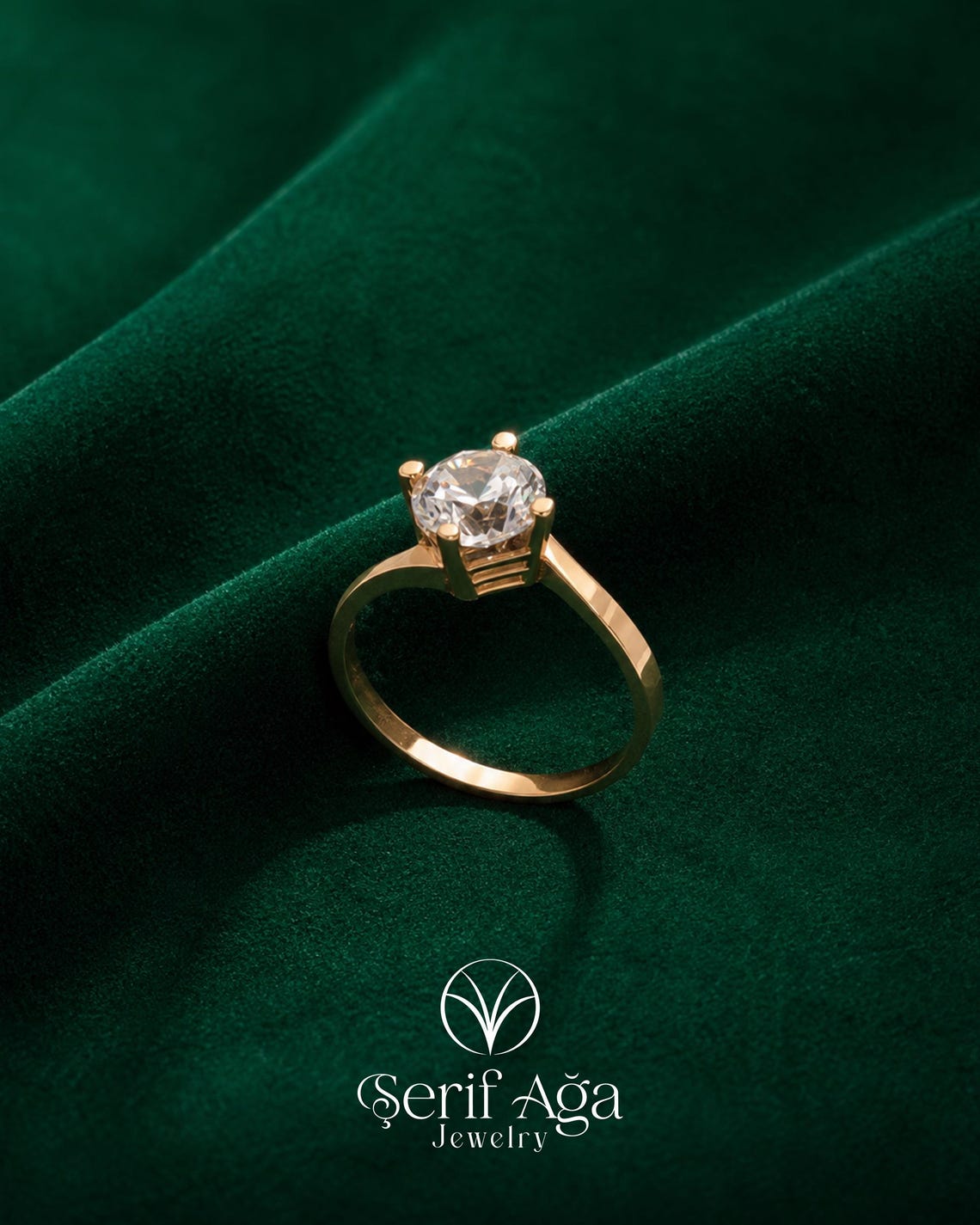
A diamond is natural (or lab-grown) crystallized carbon, the hardest natural material at 10 on the Mohs scale, while cubic zirconia (CZ) is a lab-made crystal of zirconium dioxide at about 8 to 8.5. CZ shows more colorful fire but less white brilliance, scratches and clouds sooner over years of wear, and is far less expensive.
Most of our pieces are set with cubic zirconia, and we label every one as CZ. Here is an honest comparison of the two, so you can decide which suits the piece you have in mind.
Diamond is pure carbon in a tightly bonded crystal structure. Natural diamonds form deep in the earth; lab-grown diamonds are chemically and physically the same material, made in a laboratory. Both are diamonds.
Cubic zirconia is synthetic zirconium dioxide, first produced commercially in the 1970s. It is not a "fake diamond" in the sense of being glass: it is a genuine crystal with its own properties. It is also not a lab-grown diamond, which is a common mix-up. CZ can be made colorless or in almost any color, which is why it appears as red, green, pink and blue stones in jewelry.
| Property | Diamond | Cubic zirconia |
|---|---|---|
| Material | Carbon | Zirconium dioxide |
| Mohs hardness | 10 | About 8 to 8.5 |
| Refractive index (brilliance) | About 2.42 | About 2.15 to 2.18 |
| Dispersion (fire) | About 0.044 | About 0.058 to 0.066 |
| Density | About 3.52 g/cm³ | About 5.6 to 6.0 g/cm³ |
| Heat conduction | Very high | Low |
| Long-term look | Stays crisp for generations | May scratch or cloud slightly over years |
| Relative cost | High | A small fraction of diamond |
The Mohs scale ranks scratch resistance. At 10, diamond can only be scratched by another diamond. CZ at 8 to 8.5 is still harder than quartz (7), which matters because ordinary dust contains quartz particles. That means CZ will not scratch easily in normal wear, but over years its facet edges can pick up tiny abrasions and lose some sharpness, especially on rings that knock against surfaces.
In earrings and pendants, which take far fewer knocks, CZ can look good for a very long time. In a ring worn every day, expect it to show wear sooner than a diamond would.
Brilliance is the white light returned to your eye, driven by refractive index. Diamond's is higher, so a well-cut diamond looks bright and crisp.
Fire is light split into rainbow flashes, driven by dispersion. CZ's dispersion is higher than diamond's, so CZ often throws more colored flashes. To a trained eye that extra rainbow is one of the giveaways. Many people simply like it.
Cut quality matters as much as material. A well-cut CZ can look better than a poorly cut diamond.
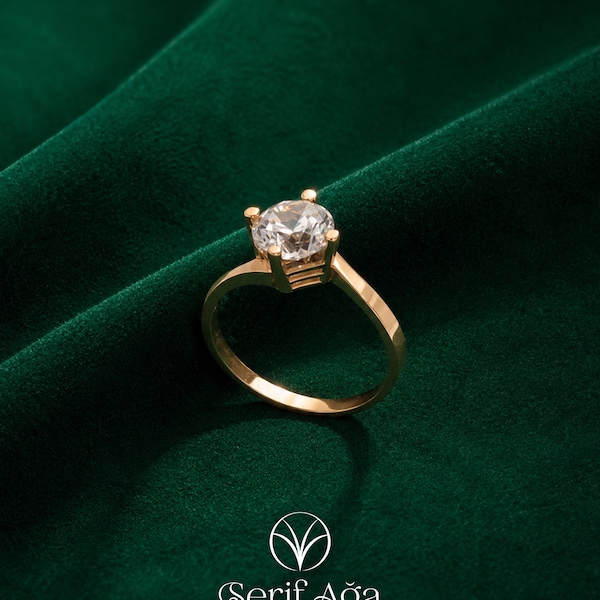 Solitaire Ring
View Solitaire Ring on Etsy
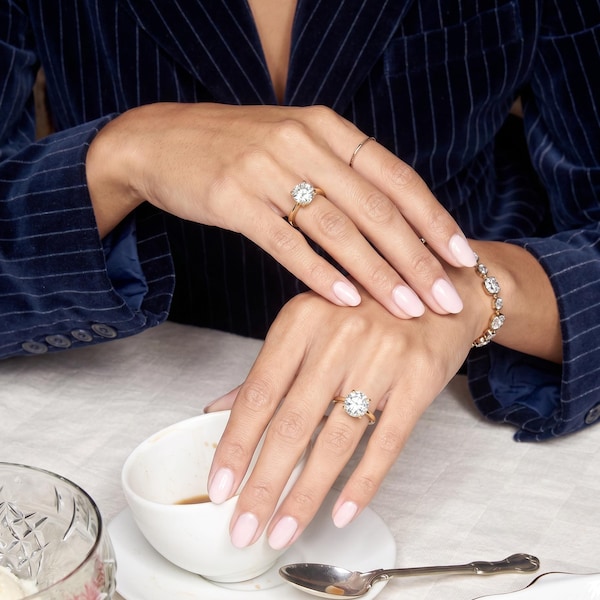 Solitaire Ring
View Solitaire Ring on Etsy
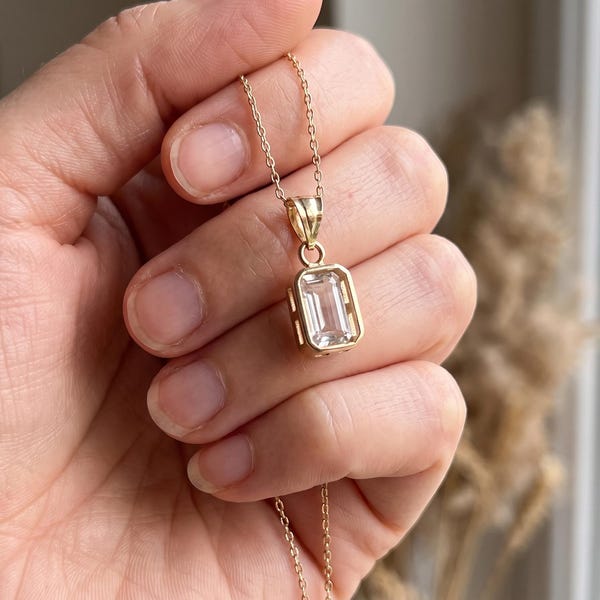 Emerald Cut Solitaire Pendant Necklace
View Emerald Cut Solitaire Pendant Necklace on Etsy
Skip the old "scratch glass" test. Both stones scratch glass, and you risk damaging the stone.
Both clean the same way: warm water, mild dish soap and a soft brush, especially behind the stone where lotion collects and dulls the sparkle. Our guide to cleaning gold jewelry at home walks through it.
With CZ, avoid harsh chemicals and abrasive cloths on the stone, and take rings off for gym work and gardening. If a CZ does become cloudy or chipped after many years, a goldsmith can replace it, and because the metal is solid gold, the setting can be re-tightened or rebuilt.
Our pave hearts, North Stars, halos and eternity bands use dozens of tiny stones. In diamond, that design moves into a very different price category. In CZ, the same craftsmanship and the same solid 14K gold setting become an everyday piece. We think gold is where lasting value should sit: the metal is what you keep, repair and pass down, and a stone can be replaced if ever needed.
That is the trade-off we have chosen for most of our collection, and you can see it across our rings and necklaces. Where we use natural stones, such as the amethyst and blue topaz in our natural stone pieces, the listing says so.
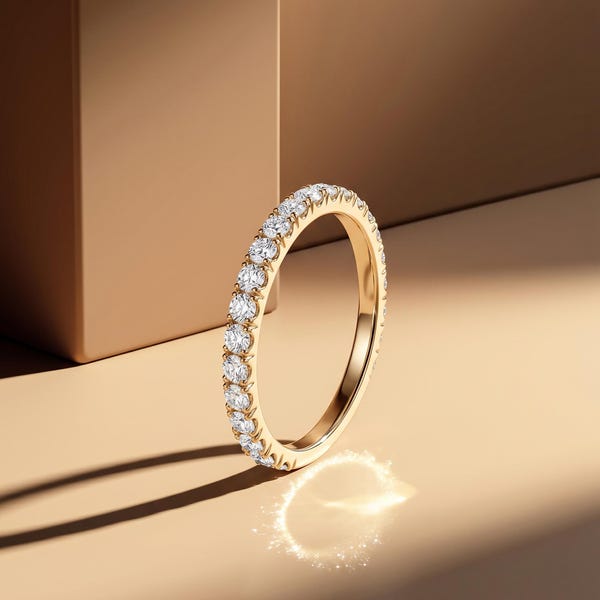 Half Eternity Ring
View Half Eternity Ring on Etsy
 North Star Necklace
View North Star Necklace on Etsy
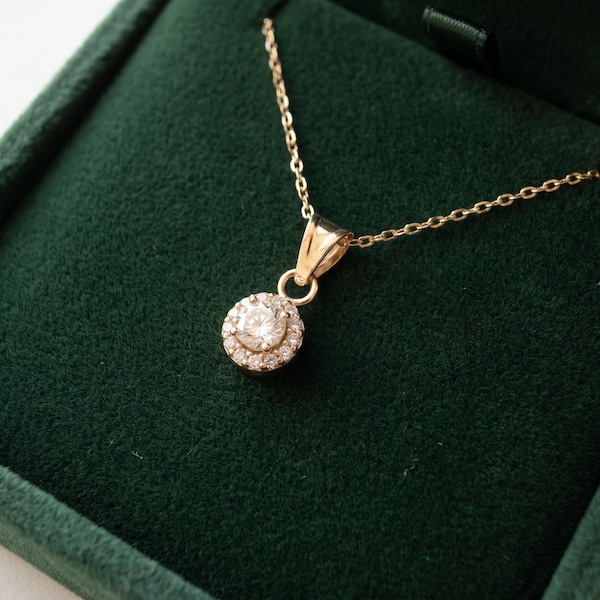 Halo Pendant Necklace
View Halo Pendant Necklace on Etsy
A stone should be named for what it is. We never describe cubic zirconia as diamond, and our listings say CZ or cubic zirconia plainly. One wording point trips people up: "diamond-cut" describes a faceted finish on the gold itself, cut to catch light. A diamond-cut chain contains no diamonds.
When you shop anywhere, look for wording like "simulated diamond", "CZ" or "lab-created", and ask directly if a listing says "diamond look" or "sparkling stones" without naming the material. If you are curious how stones relate to birth months and meanings, see our birthstone jewelry gift guide.
No. Cubic zirconia is a lab-made crystal of zirconium dioxide. It is a real gemstone material in its own right, but chemically and physically different from diamond.
No. A lab-grown diamond is carbon with the same structure as a natural diamond. Cubic zirconia is a different material that only resembles diamond.
Over years of wear, CZ can pick up fine scratches and look less crisp, and lotion buildup behind any stone makes it look cloudy. Regular cleaning helps, and a goldsmith can replace a worn stone.
Yes. A standard thermal diamond tester distinguishes diamond from CZ quickly, and a gemologist can confirm with other tests.
No. Diamond-cut describes small facets cut into the metal surface so it reflects light. It has nothing to do with diamond stones.
Share:
Find your ring size at home with a string or an existing ring, then convert between US, UK and EU sizes with our chart. Plus tips for wide bands and…
Is 14K solid gold worth it? A goldsmith family weighs cost per wear, gold value, repairs and plated alternatives, and explains when it is not the rig…
A clear gold karat chart from 8K to 24K: purity percentages, hallmark numbers like 375, 585 and 750, durability, typical uses and what each region pr…