Ring Size Guide: How to Measure at Home, With a US, UK and EU Chart
Find your ring size at home with a string or an existing ring, then convert between US, UK and EU sizes with our chart. Plus tips for wide bands and…

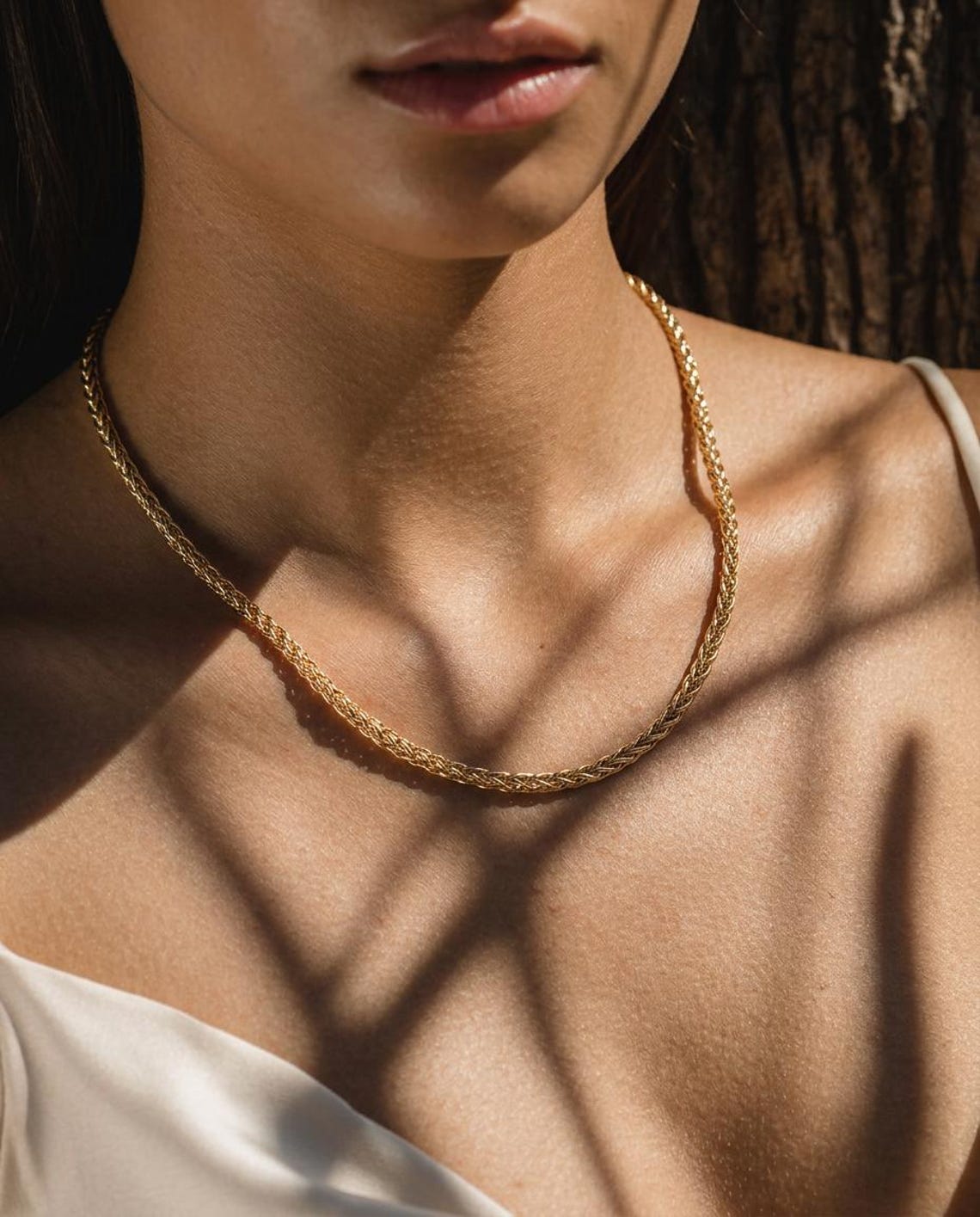
A gold karat tells you how many parts out of 24 are pure gold: 24K is essentially pure, 18K is 75% gold, 14K is 58.3% (hallmarked 585) and 10K is 41.7%. The hallmark number stamped on jewelry expresses the same thing in parts per thousand, so 585 means 585 parts of gold per 1,000.
The chart below puts every common karat side by side, with its hallmark, how it holds up in daily wear and where you are most likely to meet it. We work in 14K every day in our Grand Bazaar atelier, so we have added the practical notes we give customers across the counter.
| Karat | Gold purity | Hallmark | Durability | Typical uses |
|---|---|---|---|---|
| 8K | 33.3% | 333 | Very hard, but more prone to tarnish | Budget jewelry in parts of Europe |
| 9K | 37.5% | 375 | Hard, scratch resistant; can dull over time | UK and Ireland everyday jewelry |
| 10K | 41.7% | 417 | Hard and durable; paler color | US rings, class rings, chains |
| 14K | 58.3% (585 standard) | 585 | Strong balance of hardness, color and tarnish resistance | Everyday jewelry worldwide; very common in the US and Turkey |
| 18K | 75% | 750 | Softer, scratches more easily; rich color | Fine jewelry, engagement rings; standard in much of Europe |
| 22K | 91.6% | 916 | Soft, dents and bends more easily | Traditional bangles and wedding gold in Turkey, the Middle East and South Asia |
| 24K | 99.9% | 999 | Very soft | Bullion, coins, investment bars, some traditional jewelry |
The percentage for each karat is the karat number divided by 24. The 14K hallmark is 585 rather than 583 because many standards set 58.5% as the legal minimum, giving a small margin above the mathematical 58.3%. For the full story behind that number, read what 585 means on gold.
You will usually find the stamp on a clasp, the inside of a ring or the back of a pendant bail. It may appear as:
Marks such as GP, GF, HGE or RGP mean plated or filled, not solid gold, whatever karat number appears beside them. Our guide on how to tell if gold is real covers what to do when you are unsure.
More gold means a richer yellow color, better resistance to tarnish and more metal value. It also means a softer piece. Alloy metals such as copper, silver and zinc add hardness, so lower karats stand up better to knocks and scratches.
If you are deciding between the two most popular fine jewelry karats, our 14K vs 18K gold comparison goes deeper.
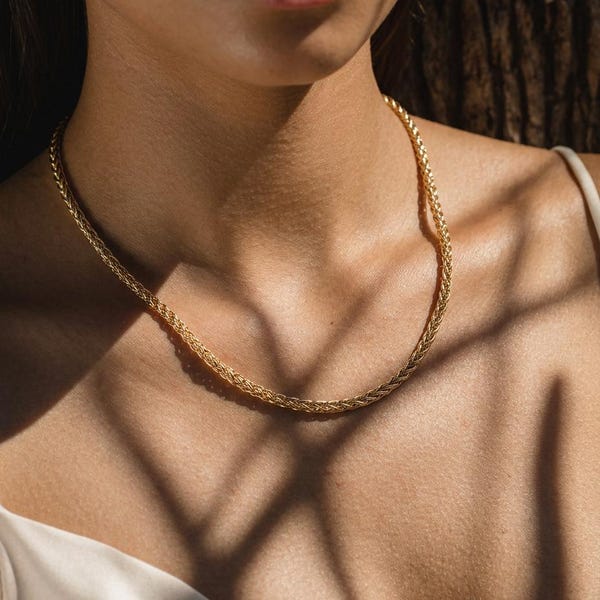 Wheat Chain Necklace
View Wheat Chain Necklace on Etsy
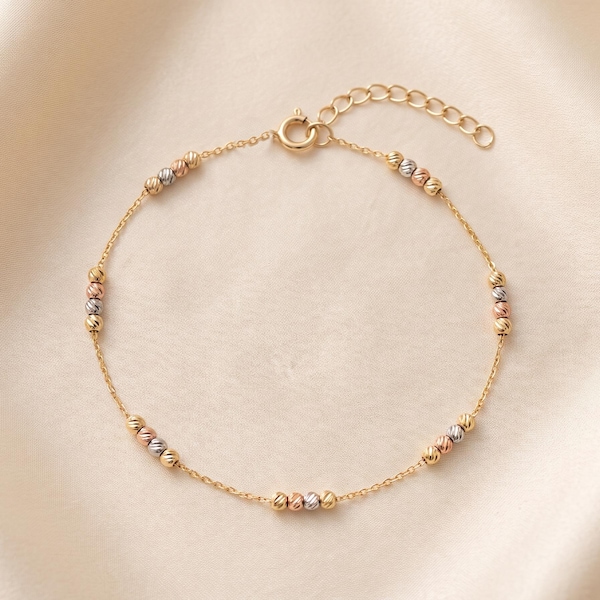 Two Tone Bracelet
View Two Tone Bracelet on Etsy
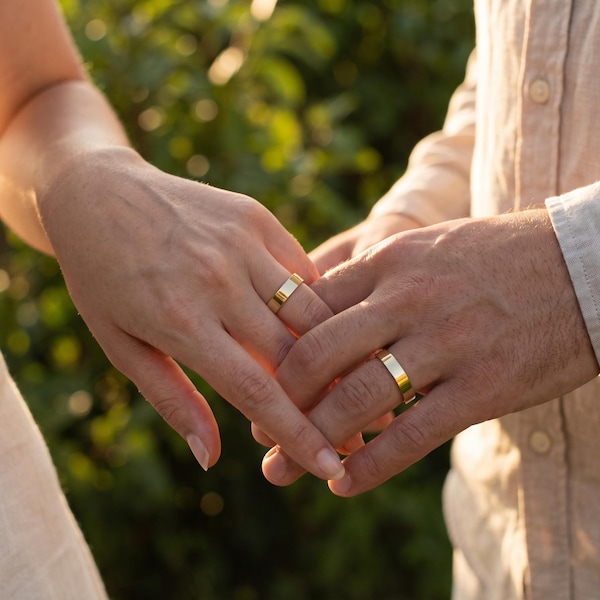 Flat Wedding Band Polished Ring for Him and Her
View Flat Wedding Band Polished Ring for Him and Her on Etsy
US rules do not allow anything below 10K to be sold as karat gold, so 10K is the floor. 14K is the most widely sold karat for everyday jewelry, with 18K common in higher-end and bridal pieces.
The UK has a long tradition of 9K for everyday jewelry, and 18K for engagement and wedding rings. Gold sold there above a set weight must be independently hallmarked by an assay office, and 375 is the lowest gold fineness the UK system recognizes.
Practice varies by country. 18K (750) is the long-standing standard in countries such as Italy and France, 14K (585) is widely used across central and eastern Europe, and 8K (333) is still found in Germany.
In Turkey, 14K is the everyday standard for fashion and fine jewelry, while 22K is the traditional choice for wedding bangles and gold given at family celebrations, valued as much for its gold content as its look. You can read more about those customs in our guide to jewelry in Istanbul's Grand Bazaar.
22K is widely used for traditional and wedding jewelry, where a deep yellow color and high gold content are preferred over hardness.
Karat measures gold content only. The color comes from the other metals in the alloy:
So a 14K white gold ring and a 14K yellow gold ring contain the same amount of pure gold. Two-tone pieces simply combine two colors of the same karat.
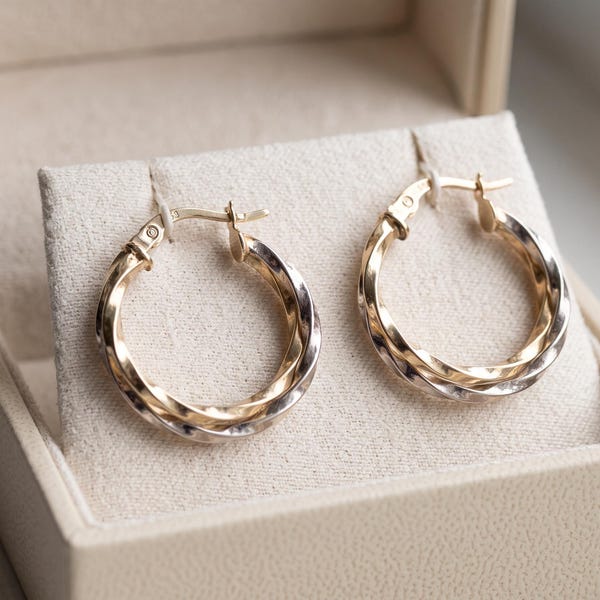 14K Two-Tone Twisted Hoop Earrings
View 14K Two-Tone Twisted Hoop Earrings on Etsy
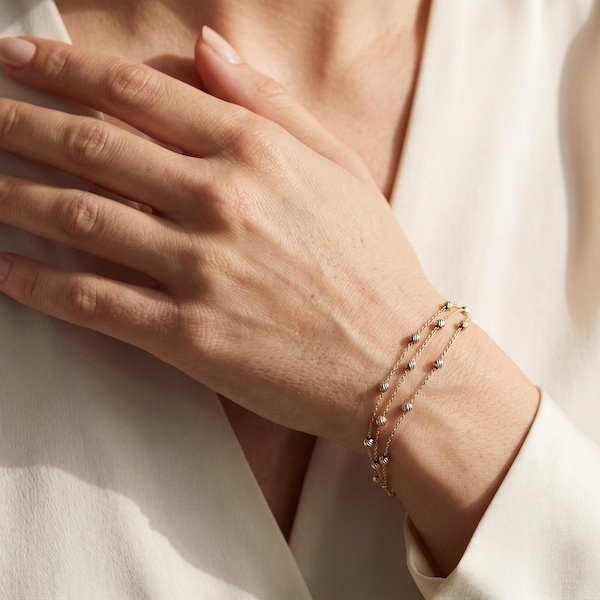 14K Solid Tri-Color Gold Double Strand Diamond Cut Bead…
View 14K Solid Tri-Color Gold Double Strand Diamond Cut Bead… on Etsy
Every piece we make is solid 14K gold, stamped 585, because it is the karat that survives real daily life best while keeping a true gold color. You can see that range across our solid gold rings and bracelets.
585 is 14 karat gold. The number means 585 parts per 1,000 are pure gold, or 58.5%.
750 is 18 karat gold, meaning 75% pure gold. It is a common standard for fine jewelry in much of Europe.
24K gold is almost pure and very soft, so it scratches, bends and dents easily. It suits coins, bars and some traditional pieces better than everyday rings and chains.
It depends on the country. In the US the minimum is 10K, the UK's lowest recognized gold fineness is 9K (375), and 8K (333) is used in some European countries.
14K balances a warm gold color and good tarnish resistance with the hardness needed for daily wear, which makes it a practical choice for rings, chains and stone settings.
Share:
Find your ring size at home with a string or an existing ring, then convert between US, UK and EU sizes with our chart. Plus tips for wide bands and…
Diamond vs cubic zirconia: how hardness, brilliance, fire and care compare, simple ways to tell them apart, and why honest labeling matters when you…
Is 14K solid gold worth it? A goldsmith family weighs cost per wear, gold value, repairs and plated alternatives, and explains when it is not the rig…