Ring Size Guide: How to Measure at Home, With a US, UK and EU Chart
Find your ring size at home with a string or an existing ring, then convert between US, UK and EU sizes with our chart. Plus tips for wide bands and…

The quickest way to tell if gold is real is to read the hallmark (such as 585, 14K, 750 or 18K), then confirm it with a non-destructive check like the magnet test and, if anything still feels wrong, a professional test by a jeweler. No single home test is proof on its own, but together they rule out most fakes and plated pieces.
We have tested gold across the counter in Istanbul's Grand Bazaar for three generations. Below is what actually works at home, what only a professional can confirm, and the popular "tests" you should skip because they tell you nothing or damage the piece.
Most real gold jewelry carries a small stamp, usually on the clasp, the inside of a ring band or the bail of a pendant. Use a magnifying glass or your phone camera zoomed in. Common stamps include:
A stamp is good evidence but not proof, because a stamp can be faked. Treat it as the first question, not the final answer. For a deeper look at the most common stamp in Europe and Turkey, read our guide to what 585 means on gold, and our gold karat chart lists every number you are likely to see.
Gold is not magnetic. Hold a strong magnet (a fridge magnet is often too weak; a small neodymium magnet works well) next to the piece. If the body of the item jumps to the magnet, it has an iron or steel core and is not solid gold. Two cautions: many fakes use non-magnetic metals such as brass or copper, so passing the test proves little, and the tiny spring inside a clasp is often steel, so a slight pull at the clasp alone is normal.
Check high-friction spots: the edges of a ring, the links near the clasp, the back of a pendant. Plated pieces wear through there first and show a silver, pink or gray base metal underneath. Solid gold is the same metal all the way through, so a scratch on it is still gold colored.
Pure gold is very dense, about 19.3 grams per cubic centimeter, much heavier than brass or steel. 14K gold is lighter than pure gold because of its alloy metals, but a solid piece still feels noticeably heavier than a costume copy of the same size. You can measure density at home with a precise scale and water displacement, but small jewelry pieces displace so little water that kitchen equipment rarely gives a reliable number. Use weight as a clue, not a verdict.
Rubbing gold on unglazed ceramic (the bottom of a mug or tile) leaves a streak: a golden streak suggests gold, a dark gray or black streak suggests something else. The problem is that you are grinding metal off your jewelry. On a thin chain or a fine pendant that is real damage for an uncertain answer. If you try it, use a hidden spot and very light pressure, or better, leave it to a jeweler who uses a proper touchstone.
People often say fake gold turns your skin green. Sometimes it does, but real 14K gold can also leave a faint mark on some people, because the 41.5% that is not gold includes copper and silver, which can react with sweat, lotion or makeup. A green finger is not proof either way.
If the piece matters, such as an inheritance or a second-hand purchase, ask a jeweler. The two main methods:
| Method | How it works | Damage to the piece |
|---|---|---|
| Acid test (touchstone) | The jeweler rubs the gold on a dark stone and applies acids of known strength to the streak. Which acids dissolve it shows the karat range. | A tiny amount of metal is rubbed off; usually invisible if done on a discreet spot. |
| XRF analyzer | An X-ray fluorescence machine reads the metals at the surface and reports their percentages. | None. |
| Electronic gold tester | Measures electrical properties of the surface to estimate karat. | None or minimal. |
One limit applies to every surface method: heavy plating over base metal can fool a quick surface test. A good jeweler knows this and will test a filed spot or check the weight if anything looks off.
Many items are "real gold" in a narrow sense: gold plated jewelry has real gold on top, and gold filled has a thicker bonded layer. Neither is solid gold. If the hallmark, wear pattern and weight all point to plating, you have your answer. Our comparison of solid gold, gold filled and gold plated explains how long each layer lasts and why the price difference exists.
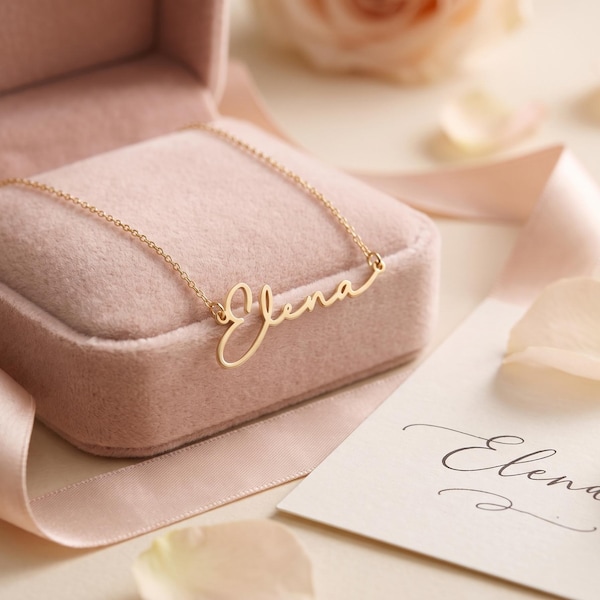 Cursive Name Necklace
View Cursive Name Necklace on Etsy
 Pave Heart Necklace
View Pave Heart Necklace on Etsy
 Wheat Chain Necklace
View Wheat Chain Necklace on Etsy
Testing is a last resort. It is easier to buy from a seller who makes the facts clear before you pay. Look for:
This is how we sell. Every piece from our atelier is solid 14K gold and stamped 585, never plated, gold filled, vermeil or semi-hollow. Most pieces use cubic zirconia and say so in the title. Returns are accepted, with the exact window shown on each Etsy listing, and Şerif Temizkan answers messages personally if you want a photo of the stamp before you order. You can browse our solid gold necklaces or rings with that in mind.
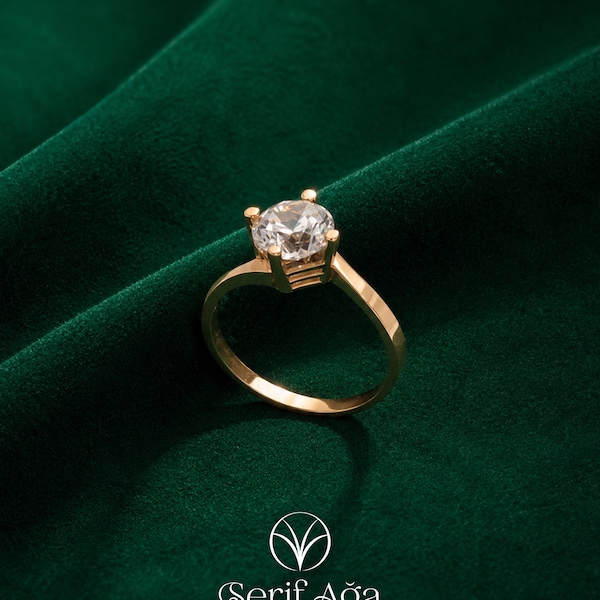 Solitaire Ring
View Solitaire Ring on Etsy
 Flat Wedding Band Polished Ring for Him and Her
View Flat Wedding Band Polished Ring for Him and Her on Etsy
No. Gold is not magnetic. If the body of a piece is pulled toward a magnet, it contains iron or steel, although the small steel spring in a clasp can cause a slight pull on its own.
585 is the hallmark for 14 karat gold, meaning 58.5% pure gold. A genuine 585 stamp means solid 14K, but stamps can be faked, so buy from a seller you trust or have it tested.
It can, occasionally. The copper and silver alloyed into 14K gold can react with sweat, lotion or makeup and leave a faint mark, so skin color alone does not prove a piece is fake.
A jeweler's XRF analyzer is the most reliable non-destructive test, and the acid test on a touchstone is a long-trusted method. Home tests can rule out obvious fakes but cannot confirm karat.
No. Biting only made sense with soft, nearly pure gold coins. Modern gold jewelry is alloyed and hard, so a bite tells you nothing and can damage the piece or your teeth.
Share:
Find your ring size at home with a string or an existing ring, then convert between US, UK and EU sizes with our chart. Plus tips for wide bands and…
Diamond vs cubic zirconia: how hardness, brilliance, fire and care compare, simple ways to tell them apart, and why honest labeling matters when you…
Is 14K solid gold worth it? A goldsmith family weighs cost per wear, gold value, repairs and plated alternatives, and explains when it is not the rig…