Rose Gold Jewelry Guide: What It Is, How It Wears and How to Style It
Our rose gold jewelry guide explains what makes gold pink, how 14K rose gold wears, who it suits and how to style and care for it. Read before you ch…

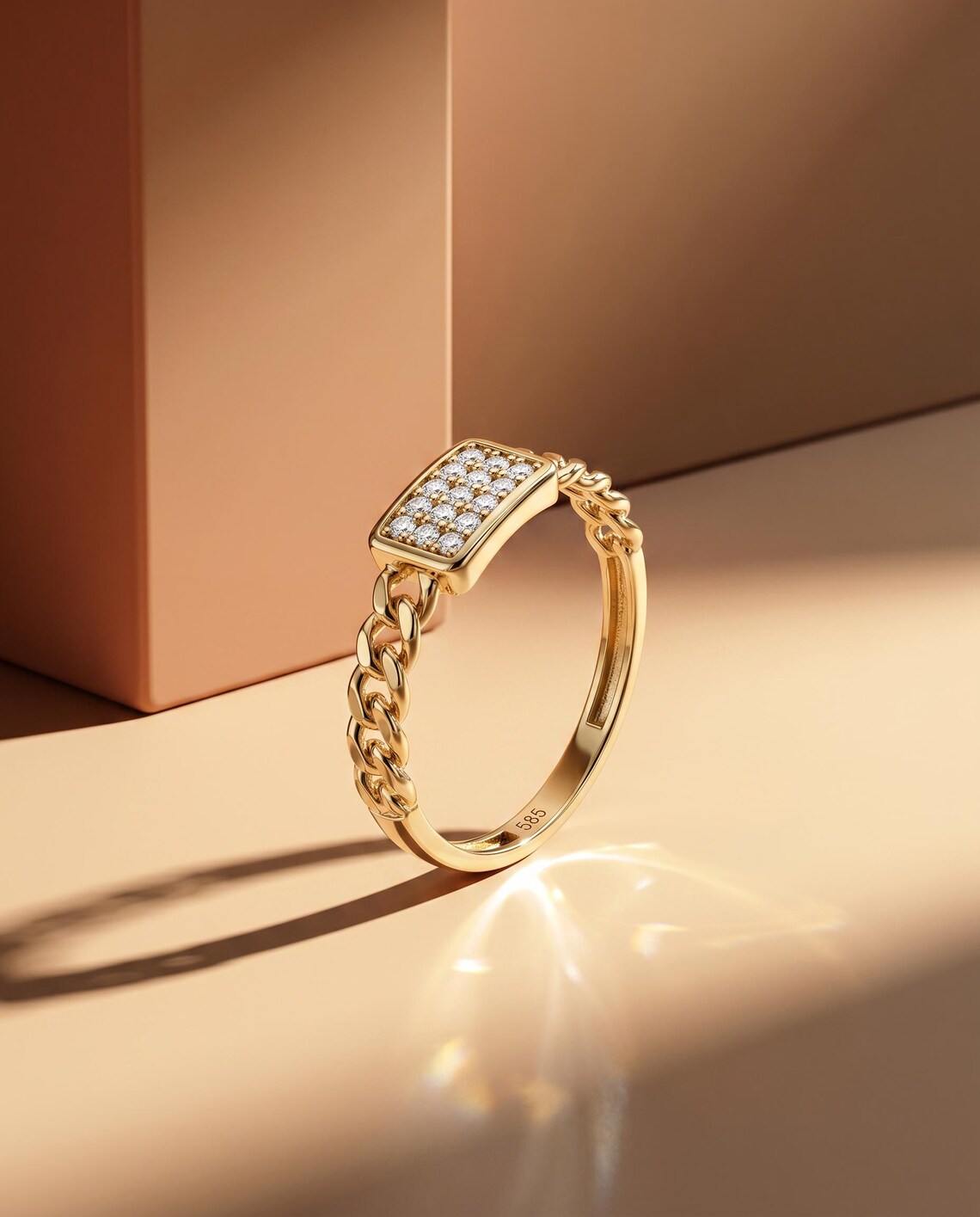
A gold signet ring is a ring with a flat or slightly curved face, called the table, that is traditionally engraved with initials, a crest or a symbol. Once used to press a seal into wax, today it is worn as a personal, everyday statement ring by men and women alike, usually on the pinky or ring finger.
This guide covers where signet rings come from, the main styles, how to choose the size and finger, and how to care for a solid gold signet ring. For other ring shapes, our gold ring styles guide gives the full overview.
Signet rings are among the oldest kinds of jewelry. Seals carved with a personal mark were used in the ancient Near East and Egypt to sign documents and secure goods, and the idea of wearing the seal on a ring spread widely in the ancient Mediterranean world. Pressing the engraved face into wax or clay left an impression that acted as a signature.
Over the centuries, signet rings became closely linked with families, officials and merchants, who used them to authenticate letters and contracts. As written signatures replaced seals, the ring kept its meaning as a mark of identity. That is still why many people choose one today: it is a ring that says something about who you are.
The word "signet" now covers a broad family of rings with a prominent top. The main differences are the shape of the face, the decoration and the band.
| Style | Face | Look | Good for |
|---|---|---|---|
| Classic oval | Flat oval table | Traditional | Initials, monograms |
| Round | Flat circle | Soft, balanced | Single initials, symbols |
| Square or cushion | Flat square | Modern, strong | Bold initials, wider hands |
| Stone-set or pave | Set with stones | Sparkling statement | Evening wear, gifts |
| Textured or chain-style | Pattern instead of engraving | Contemporary | Everyday stacking |
A classic signet face is engraved, either by hand or by machine, with initials, a family crest or a small symbol. Some people leave the face polished and plain, which is a cleaner look and leaves room to engrave it later. Whether a particular ring can be personalized is shown on its listing; you can also browse our personalized pieces.
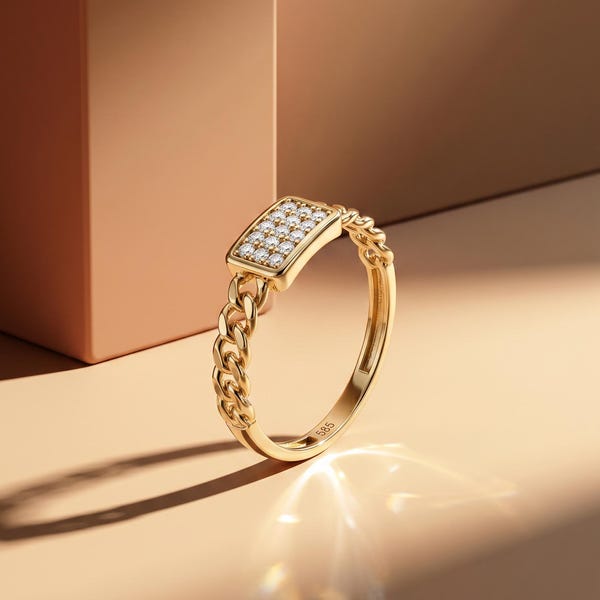
Contemporary designers often borrow the signet's chunky top and flat face but use texture, chain patterns or stones instead of engraving. Our Cuban chain signet ring is a good example: it keeps the strong silhouette, with a pave face of cubic zirconia (CZ) and a Cuban link band.
In general, signet rings are either cast or fabricated. With casting, a wax model of the ring is carved or printed, encased in plaster-like investment, then burned out and replaced with molten gold, a method known as lost-wax casting. With fabrication, a goldsmith shapes the band and top from sheet and wire and solders them together. Either way, the ring is then filed, sanded, polished and, if required, engraved or set with stones.
Because the top of a signet ring is thick, the ring carries a fair amount of gold. That is part of its satisfying weight and part of why solid construction matters: a signet ring takes knocks on the top of the hand. All of our rings are solid 14K gold stamped 585. For more about casting, read lost-wax casting explained.
There is no single rule, but traditions exist:
Comfort matters more than tradition. A chunky signet can feel bulky next to other rings, so try it where it does not knock against neighboring rings when you make a fist.
Wide bands fit more snugly than thin ones, and signet rings usually have a wider top and a tapering band. Many goldsmiths suggest going up a quarter or half size for very wide bands. Pinky fingers also vary a lot in size from person to person, so measure the exact finger you plan to wear it on. Our ring size guide explains how to measure at home.
If a ring does not fit, ask before resizing. Whether a ring can be resized depends on its design, especially if it has stones or patterns all the way around. Our article on whether gold rings can be resized explains the details.
A signet ring worn alone on the pinky is the most classic look. It suits tailored clothing as well as a T-shirt and jeans.
Pair a signet with a plain flat band on a neighboring finger for a balanced look, or wear a slim band directly beside it on the same finger. Chunky textured rings can also sit nearby if you like a bolder hand.
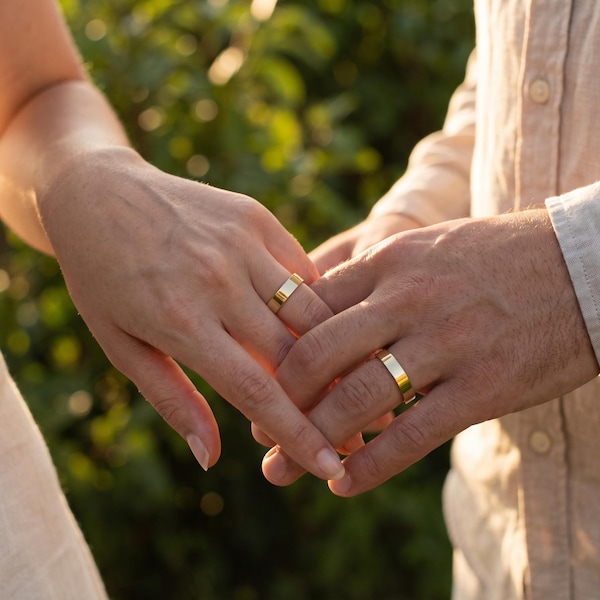 Flat Wedding Band Polished Ring for Him and Her
View Flat Wedding Band Polished Ring for Him and Her on Etsy
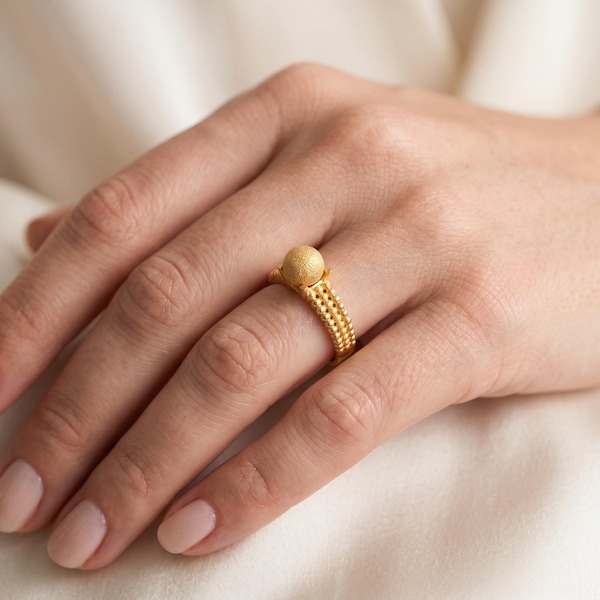 Chunky Gold Ring
View Chunky Gold Ring on Etsy
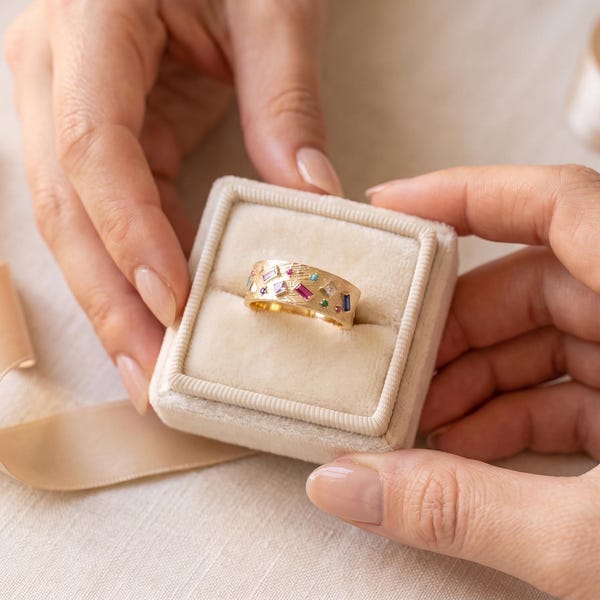
A signet looks best when the rest of your jewelry is calm. A curb or rope bracelet and a watch on the same hand create a cohesive look. For a bolder Ottoman-inspired option, a wide textured band set with stones gives a similar weight and presence.
Solid 14K gold will not tarnish or peel, and our lifetime guarantee covers the craftsmanship.
Traditionally the pinky of the non-dominant hand, but today people wear signet rings on any finger. Choose the finger where it feels comfortable and does not knock against other rings.
Yes. Signet rings have been worn by both men and women for centuries, and smaller faces and pave designs are especially popular with women today.
It should slide over the knuckle with slight resistance and not spin. Because signet bands are wide, many people need a slightly larger size than for a thin band.
A plain polished face can usually be engraved later by a jeweler. Pave or textured faces cannot be engraved in the same way.
Yes. All of our rings are solid 14K gold stamped 585. Any stones are described on each listing, and cubic zirconia is always named as such.
Share:
Our rose gold jewelry guide explains what makes gold pink, how 14K rose gold wears, who it suits and how to style and care for it. Read before you ch…
Curb chain guide from Grand Bazaar goldsmiths: how curb and Cuban links are made, why they are so durable, how to style them and how to keep them cle…
Solid gold vs sterling silver compared honestly: tarnish, durability, skin sensitivity, care and value. Goldsmiths explain when each metal makes sens…