Heart Necklace Meaning: History, Open vs Closed Hearts and Heart Keys
Heart necklace meaning: how the heart became a love symbol, open vs closed vs puffed hearts, heart key pendants, and gift ideas for partners and daug…

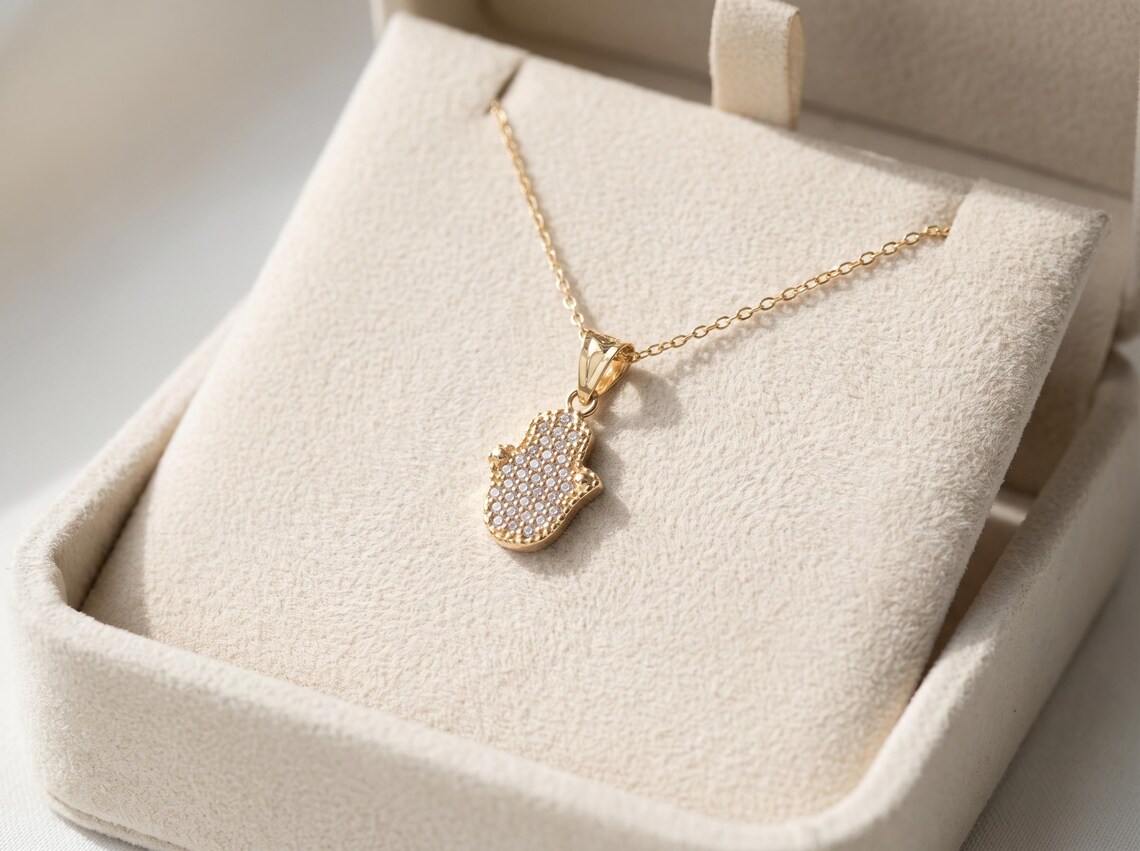
The hamsa hand is an open-palm amulet that has been worn across the Middle East and North Africa for centuries as a traditional sign of protection and blessing. It is shared by Muslim, Jewish and Christian communities alike, and today many people also wear it simply as a sign of good wishes and heritage.
Below we look at where the hamsa comes from, what people say about fingers pointing up or down, why it is so often paired with the blue eye, and how to choose a hamsa piece in solid gold that you will actually wear every day.
In folk tradition the hamsa is a hand raised to stop harm. The open palm says "halt" to bad luck and to the envious look known in many cultures as the evil eye. Over time it also took on gentler meanings: blessing, strength, good fortune and the protection of a home or family.
It is worth saying plainly: these are beliefs and customs, not promises. Nobody can guarantee that a pendant changes what happens to you. What a hamsa can do is carry a story, a family memory or a wish from the person who gave it, and for many wearers that is the real point.
The word hamsa (also written khamsa or hamesh) comes from the Semitic root for "five", a reference to the five fingers. Hand-shaped protective symbols appear in the Mediterranean and Near East long before the major religions of the region, and some historians link the hamsa to these older traditions. The exact origin is debated, so treat any single neat story with caution.
The hamsa is often called the Hand of Fatima, after the daughter of the Prophet Muhammad. In North Africa especially it is seen on doors, in homes and as jewelry. Some people connect the five fingers to the Five Pillars of Islam, a later interpretation that many families still share.
Among Sephardic and Mizrahi Jews the same symbol is often called the Hand of Miriam, after the sister of Moses and Aaron. Some link the five fingers to the five books of the Torah. It is a common sight on wall hangings, baby gifts and necklaces.
Many Christians in the region, and many people with no religious connection at all, wear the hamsa as a cultural sign of protection and goodwill. In Istanbul's Grand Bazaar, where our atelier sits, you will see it next to the nazar on almost every street. If you are curious about the wider culture of the bazaar, our Grand Bazaar jewelry guide is a good place to start.
You will find hamsas drawn both ways, and modern explanations usually go like this:
These readings are popular but not ancient rules. In many traditional pieces the hand is simply symmetrical, with two thumbs, and can be worn either way. Choose the orientation that feels right to you, or the one your family has always used.
| Orientation | Common modern reading | Who often chooses it |
|---|---|---|
| Fingers up | Protection, warding off envy | Wearers who want a protective keepsake |
| Fingers down | Blessing, abundance, welcome | Gifts for new homes, babies, new beginnings |
| Symmetrical, no clear direction | Both meanings at once | Traditional and heirloom styles |
A hamsa with a blue eye in the palm is one of the most familiar designs in the region. The two symbols are separate traditions that grew up side by side: the nazar (the blue glass eye) is said to "look back" at the evil eye, while the hand blocks it. Put together, they are a doubled wish for protection.
We explain the eye in detail in our guide to the Turkish evil eye. We don't currently list a single pendant that combines the hand and the eye, but layering a hamsa necklace with a nazar piece gives a similar look and lets you wear each one alone too.
 Evil Eye Necklace
View Evil Eye Necklace on Etsy
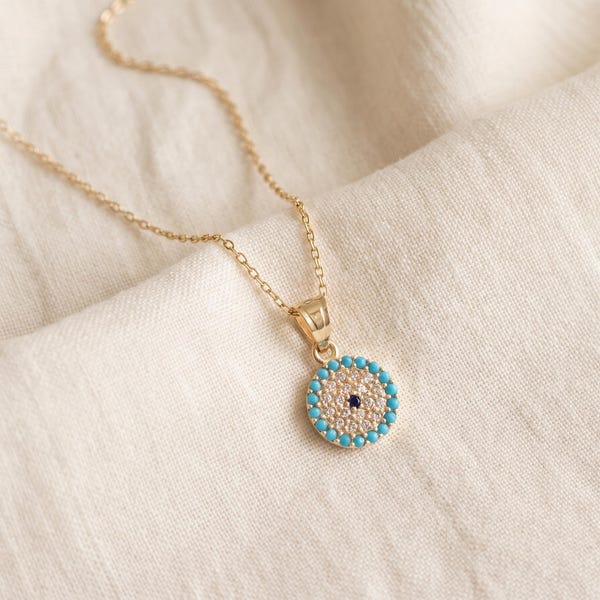 Turquoise Evil Eye Necklace
View Turquoise Evil Eye Necklace on Etsy
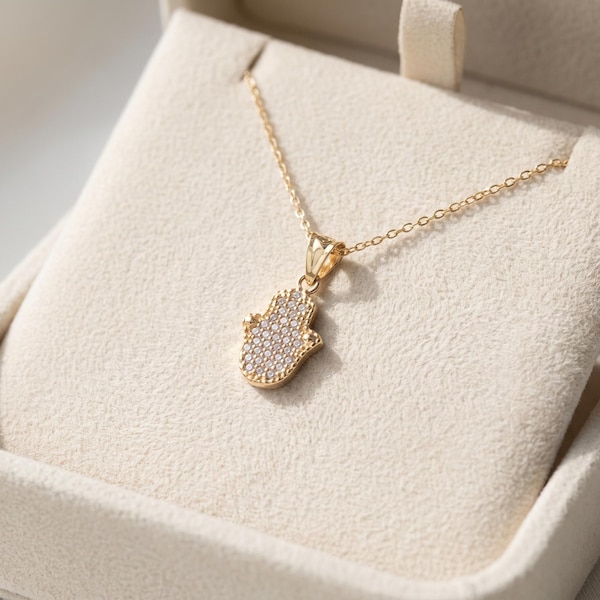
A protective symbol only works as a keepsake if it is on you, so choose something comfortable. A small to medium pendant sits well on a fine chain and does not catch on clothing. Our Pave Hamsa Necklace is set with cubic zirconia (CZ), not diamonds, which gives sparkle while keeping the piece practical. CZ is a clear, hard stone that is honest about what it is, and it keeps the pendant easy to wear.
Most people wear a hamsa at the collarbone, where it is visible and lies flat. If you are unsure, our necklace length guide walks through each length with real examples.
A hamsa pairs naturally with a nazar, a small star or a simple chain. Keep the pendants at different lengths, two or three centimeters apart, so they do not tangle. Many wearers combine the hand with a crescent moon and star or a four-leaf clover to bring several traditions of good wishes together.
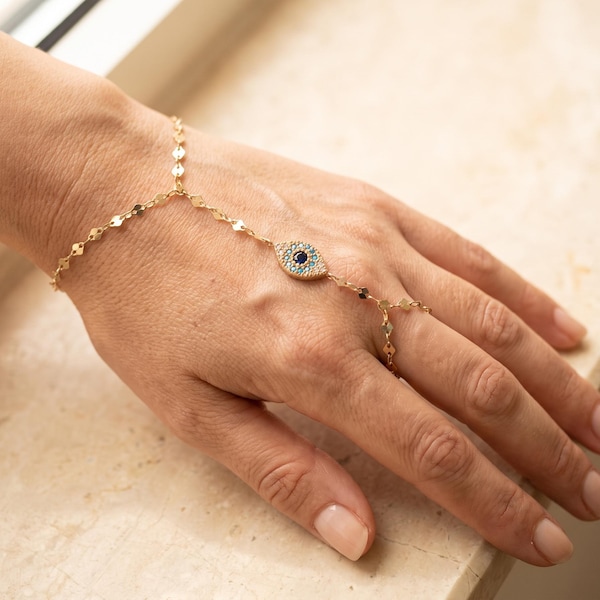
If you prefer to keep the eye on your hand, an evil eye hand chain is a lovely companion to a hamsa necklace. Browse our hand chains or the full necklace collection.
Symbols like the hamsa are often given at births, weddings and moves, and they tend to be worn for decades. That is why we make every piece in solid 14K gold, stamped 585. It will not flake like plating, it is fine for daily wear, and it can be passed down. Every order also arrives in our illuminated jewelry box, so it is ready to give.
A hamsa is a thoughtful gift for a new baby, a new home, a graduation or someone starting a difficult chapter. Because it is shared across faiths, it is generally a respectful choice, but if you are giving it to someone of a specific faith, it is kind to know which name and meaning their family uses. A short note explaining why you chose it ("to keep you safe on your new path") makes the gift personal.
Yes. The hamsa is widely worn as a cultural symbol of protection and goodwill by people of many faiths and none. Wearing it respectfully and knowing its background is what matters.
Popular modern readings say fingers up is protection and fingers down is blessing. There is no strict rule, so choose the one that feels meaningful to you.
The hamsa is a hand and the evil eye (nazar) is a blue eye. They are separate folk traditions that are often combined, both associated with warding off envy.
Yes. Every piece is solid 14K gold stamped 585, never plated or gold-filled. The stones in the Pave Hamsa Necklace are cubic zirconia.
Yes. Solid 14K gold is made for daily wear. Gold itself is not harmed by water, though soap and lotion can dull the shine over time.
Share:
Heart necklace meaning: how the heart became a love symbol, open vs closed vs puffed hearts, heart key pendants, and gift ideas for partners and daug…
Infinity symbol jewelry meaning: where the lemniscate came from, why it means endless love, infinity heart designs in solid 14K gold and gift ideas.
North star necklace meaning: why Polaris stands for guidance, how it differs from the Star of Bethlehem, and why it makes a fitting graduation or tra…