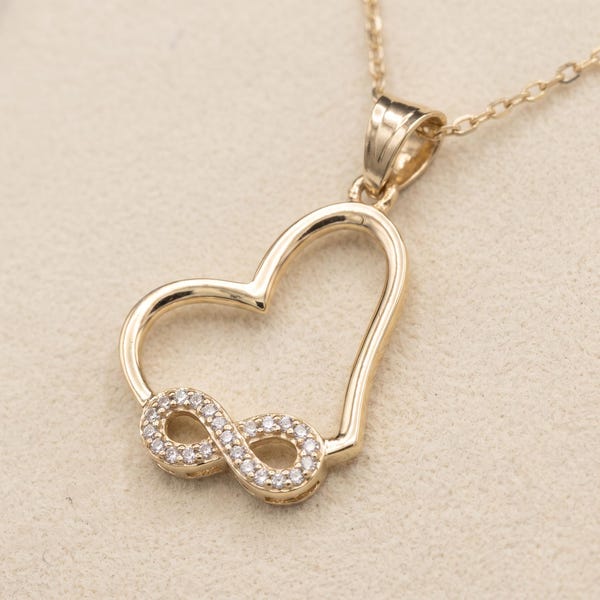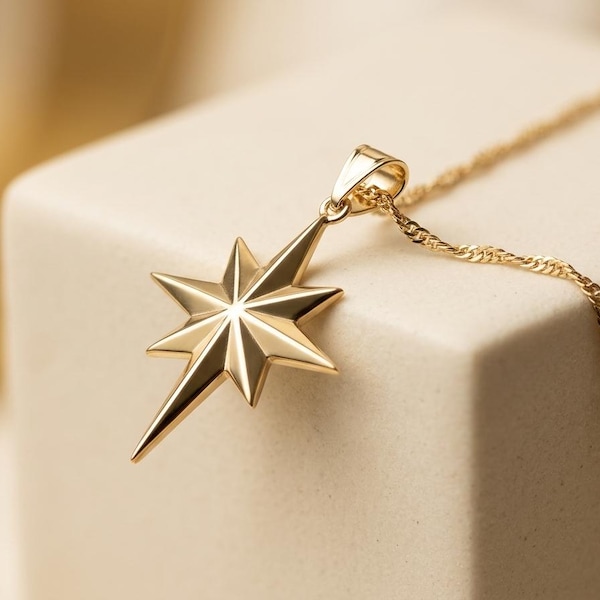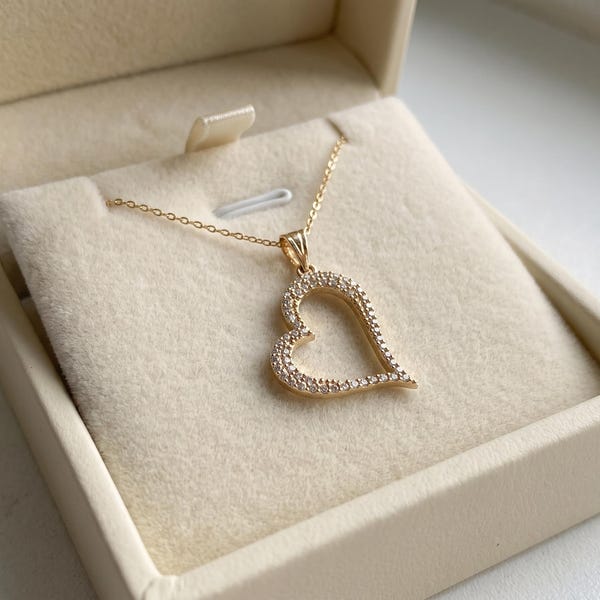
Heart Necklace Meaning: History, Open vs Closed Hearts and Heart Keys
Heart necklace meaning: how the heart became a love symbol, open vs closed vs puffed hearts, heart key pendants, and gift ideas for partners and daug…


Turquoise jewelry is traditionally worn for protection, good fortune and friendship, and the stone's name itself means "Turkish." It reached medieval Europe through Turkish trade routes, so the French called it pierre turquoise, the Turkish stone. Today it is also one of the main December birthstones.
As a Grand Bazaar atelier, we have a soft spot for it. Here is the history behind the name, what turquoise has meant across cultures, how to care for a stone that is softer and more porous than most, and how our turquoise pieces are described.
Turquoise is an opaque mineral made of copper and aluminum, formed where water seeps through rock over very long periods. Copper gives the sky blue color; iron pushes it toward green. Many stones show a darker web of host rock called matrix, which some people love as a sign of character.
It is relatively soft, about 5 to 6 on the Mohs scale, and porous, which means it can absorb oils and liquids. Much turquoise on the market is stabilized, meaning treated with resin to make it more durable and hold its color. This is common across the trade.
Historically, a lot of fine turquoise came from Persia (today's Iran) and traveled west through Anatolia and Ottoman markets. European buyers met the stone through Turkish merchants, and the name stuck. In Turkish, the color is turkuaz, and turquoise is also tied to the deep blue of the nazar, the evil eye bead.
The connection runs deeper than trade. Turkic peoples of Central Asia prized the stone long before the Ottoman era, and turquoise beads and inlays appear in horse fittings, belts and headdresses across the steppe. Blue was associated with the sky, which held great importance in early Turkic belief, and the color carried that sense of the heavens into everyday objects.
Turquoise and blue glass appear side by side in Ottoman and Anatolian jewelry, horse tack, tiles and mosque decoration. In the Grand Bazaar you will still see the color everywhere. Our guide to Turkish jewelry traditions explains more of that heritage.
Similar beliefs appear in Ancient Egypt and among Native American peoples of the Southwest, where turquoise has deep cultural importance. These are traditions and stories, not promised effects, but they explain why turquoise feels so personal to so many people. If the protective side interests you, read our guide to the Turkish evil eye.
Turquoise is one of the traditional December birthstones, alongside zircon and tanzanite, with blue topaz added in many modern lists. It is also linked with the eleventh wedding anniversary in some traditions. For December's other blue option, see our blue topaz jewelry meaning guide.
We name every piece the way its listing describes it, so here is how our turquoise designs are titled:
| Piece | How the listing describes it |
|---|---|
| Turquoise Station Necklace | Bezel set, December birthstone |
| Turquoise Station Bracelet | Dainty bezel set chain |
| Turquoise Evil Eye Necklace | Dainty nazar disc pendant |
| Turquoise Star Pendant Necklace | Dainty celestial pendant |
| Phoenix Necklace | Turquoise CZ wing pendant, Figaro chain (cubic zirconia) |
| Baby ID Bracelet | Pink or turquoise enamel star (enamel, not a stone) |
For the station pieces, the evil eye disc and the star pendant, the listing gives the stone details. Check there, or message us, if natural origin is important to you. The Phoenix necklace uses turquoise-colored CZ, and the Baby ID bracelet uses turquoise enamel, and we say so plainly.
 Turquoise Station Necklace
View Turquoise Station Necklace on Etsy
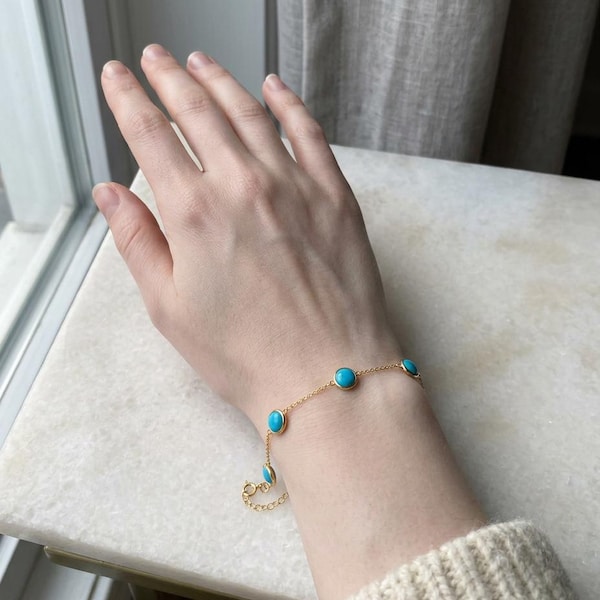 Turquoise Station Bracelet
View Turquoise Station Bracelet on Etsy
The station necklace and bracelet make a matching pair for layering. The bezel setting, where a thin gold rim wraps the stone, protects the edges of a softer stone well.
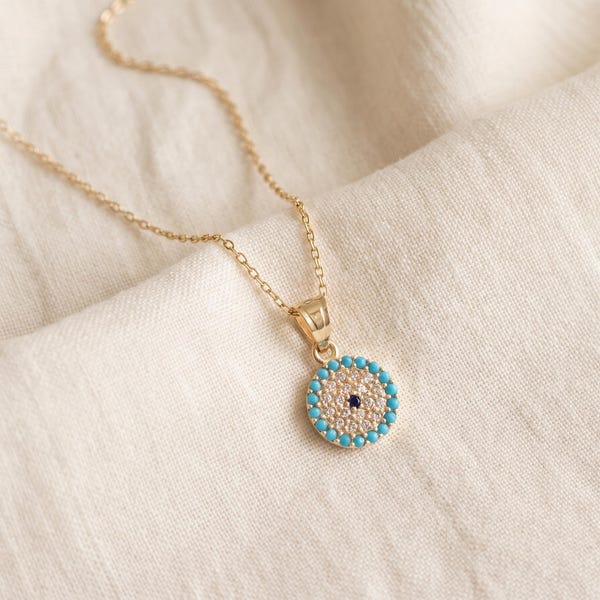 Turquoise Evil Eye Necklace
View Turquoise Evil Eye Necklace on Etsy
 Turquoise Star Pendant Necklace
View Turquoise Star Pendant Necklace on Etsy
Browse more in our necklaces and our bracelets.
Because turquoise is porous and softer than most gems, a little care keeps its color even.
Untreated turquoise can slowly deepen or shift toward green as it absorbs skin oils over years of wear. Some collectors treasure this as a patina that records the stone's life with its owner. Stabilized turquoise changes much less. Either way, the habits above slow any change and keep the color even.
If your turquoise ever looks dull, do not reach for polish or jewelry dip. A gentle wipe with a soft cloth is usually enough, and if the gold needs more attention, clean the metal carefully around the stone rather than soaking the whole piece.
The solid 14K gold around the stone needs no special care beyond this; it does not flake or wear through.
Turquoise suits December birthdays, eleventh anniversaries, friends heading off on a long journey, and anyone with Turkish or Persian roots who wants a piece that feels like home. Its cheerful color also makes it a good first piece of fine jewelry for someone who usually wears little gold. Every order arrives in our illuminated jewelry box, ships free by tracked, insured express to the USA, UK and Europe, and is backed by our lifetime craftsmanship guarantee.
The name comes from French pierre turquoise, meaning Turkish stone, because Europeans first bought it through Turkish trade routes.
In many traditions it stands for protection, safe travel, friendship and good fortune. These are folklore meanings, not guaranteed effects.
Yes. Turquoise is one of the traditional December birthstones, along with zircon and tanzanite.
It is best not to. Turquoise is porous, so soap, water and chemicals can change its color over time.
No. Its listing describes turquoise-colored CZ wings, so it is cubic zirconia set in solid 14K gold.
Share:
Heart necklace meaning: how the heart became a love symbol, open vs closed vs puffed hearts, heart key pendants, and gift ideas for partners and daug…
Infinity symbol jewelry meaning: where the lemniscate came from, why it means endless love, infinity heart designs in solid 14K gold and gift ideas.
North star necklace meaning: why Polaris stands for guidance, how it differs from the Star of Bethlehem, and why it makes a fitting graduation or tra…