Can You Swim with Gold Jewelry? Chlorine, Salt Water and Sunscreen
Can you swim with gold jewelry? What chlorine, salt water and sunscreen do to 14K gold, why rings get lost, and how to clean pieces after a swim.

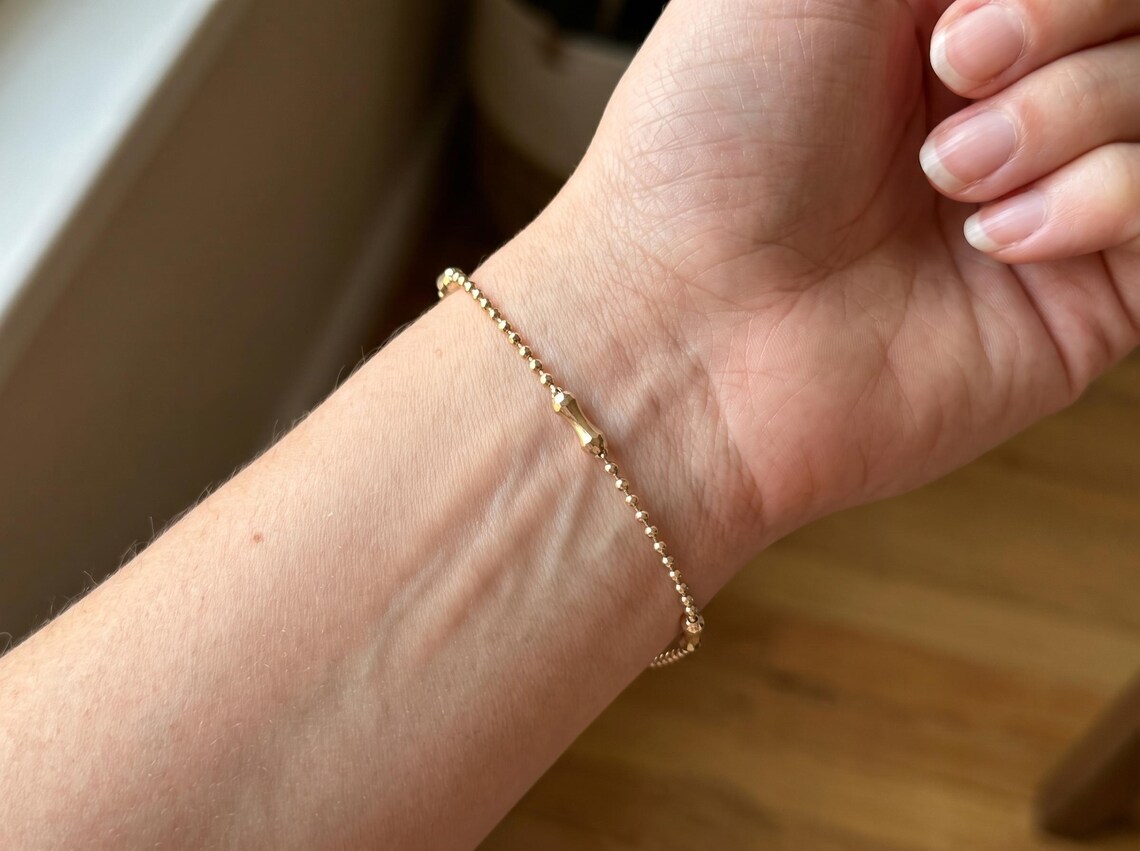
To find your bracelet size, measure around your wrist where you normally wear a bracelet, then add 1.5 to 2.5 cm (about 1/2 to 1 inch) depending on how loose you like it. For most adults, that lands somewhere between 16 and 20 cm (about 6.3 to 7.9 inches), and 18 cm (about 7 inches) is the most common women's bracelet length.
Here is how to measure properly, how much room to leave, and how chain style changes the fit.
You need a soft tape measure, or a strip of paper and a ruler.
Do not use a metal tape measure or a phone charger cable: neither wraps accurately. If you have a bracelet that already fits well, you can also lay it flat, clasp open, and measure it end to end, including the clasp.
A bracelet should never be exactly the size of your wrist, or it would not close. The extra length is called ease, and it decides how the bracelet moves:
| Wrist size | Snug fit | Comfort fit | Loose fit |
|---|---|---|---|
| 13 cm (5.1 in) | 14.5 cm (5.7 in) | 15 cm (5.9 in) | 15.5 cm (6.1 in) |
| 14 cm (5.5 in) | 15.5 cm (6.1 in) | 16 cm (6.3 in) | 16.5 cm (6.5 in) |
| 15 cm (5.9 in) | 16.5 cm (6.5 in) | 17 cm (6.7 in) | 17.5 cm (6.9 in) |
| 16 cm (6.3 in) | 17.5 cm (6.9 in) | 18 cm (7.1 in) | 18.5 cm (7.3 in) |
| 17 cm (6.7 in) | 18.5 cm (7.3 in) | 19 cm (7.5 in) | 19.5 cm (7.7 in) |
| 18 cm (7.1 in) | 19.5 cm (7.7 in) | 20 cm (7.9 in) | 20.5 cm (8.1 in) |
| 19 cm (7.5 in) | 20.5 cm (8.1 in) | 21 cm (8.3 in) | 21.5 cm (8.5 in) |
| 20 cm (7.9 in) | 21.5 cm (8.5 in) | 22 cm (8.7 in) | 22.5 cm (8.9 in) |
One inch is 2.54 cm, so the inch values are rounded. If you fall between two sizes, choose the larger one for chain bracelets: a bracelet that is slightly loose is comfortable, while one that is slightly tight pinches and puts strain on the clasp.
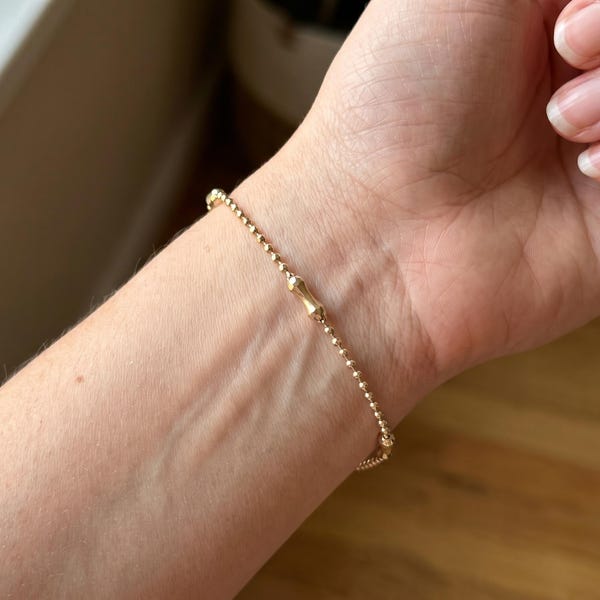 Diamond-Cut Ball Chain Bracelet
View Diamond-Cut Ball Chain Bracelet on Etsy
 Paperclip Bracelet
View Paperclip Bracelet on Etsy
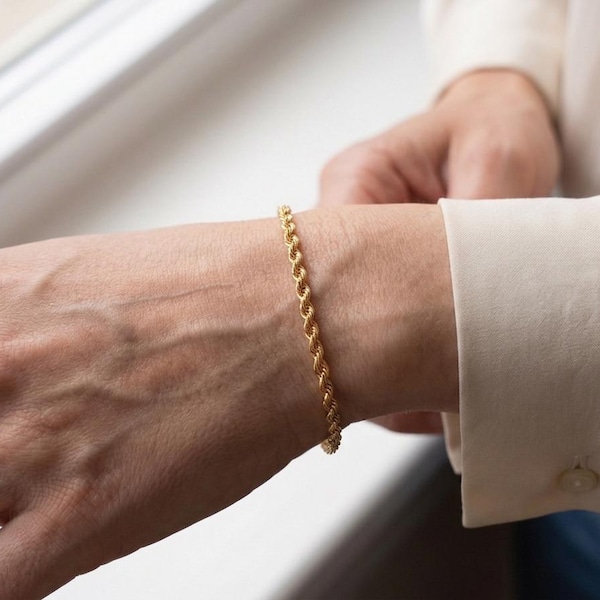 Rope Chain Bracelet
View Rope Chain Bracelet on Etsy
The same length can fit differently depending on the chain. Thicker links take up space on the inside of the bracelet, so they feel smaller than a fine chain of the same length.
| Bracelet style | Fit advice |
|---|---|
| Fine cable, rolo or paperclip chain | Use the chart as it is. |
| Bead or ball chain | Add about 0.5 cm, as round beads sit on the wrist. |
| Chunky curb, Cuban, mesh or rope | Add 0.5 to 1 cm, as thick links reduce the inner space. |
| Charm bracelets | Choose a loose fit so charms hang freely. |
| Bangles and cuffs | Sized differently; see below. |
A chain bracelet opens with a clasp, so it only needs to fit around your wrist. A bangle is a rigid circle with no clasp, so it has to pass over your hand. That means bangles are sized by hand, not wrist.
To size a bangle, bring your thumb and little finger together as if putting on a bangle, then measure around the widest part of your hand, across the knuckles. The inner circumference of the bangle needs to be at least that size. Hinged bangles and cuffs are easier to fit because they open.
Most of our bracelets are chain bracelets with secure clasps, which are easier to size and to adjust.
If you are buying a gift and do not know the wrist size, choose an adjustable bracelet. These have extension rings, a sliding clasp or a chain that can be fastened at more than one point, so one bracelet fits a range of wrists. They are also useful if your wrist size changes between seasons.
Many of our bracelets are adjustable, and the listing shows the length range. If you need a different length in a non-adjustable chain, message us before ordering and we will tell you what is possible for that piece. Because every piece is solid 14K gold, a goldsmith can resize a chain; plated chains generally cannot be altered in the same way. Our guide to solid gold vs gold filled vs gold plated explains why.
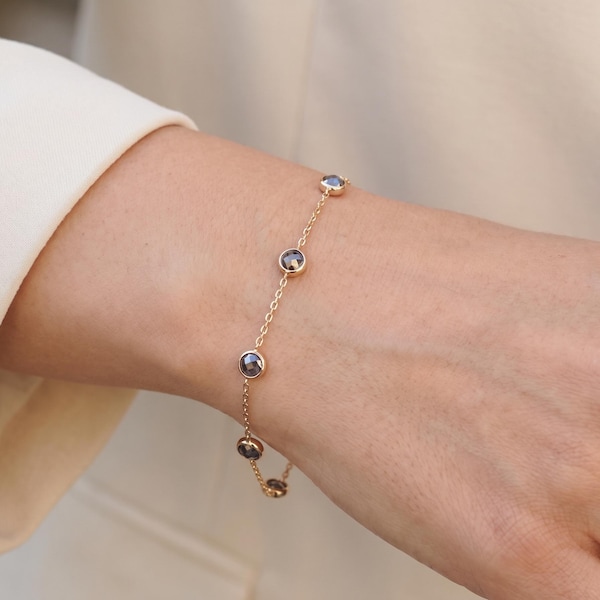 CZ Bezel Station Bracelet
View CZ Bezel Station Bracelet on Etsy
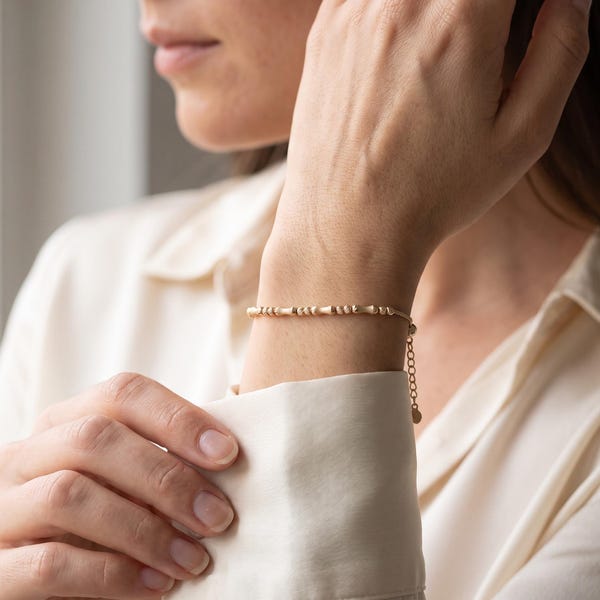 Mom Bracelet
View Mom Bracelet on Etsy
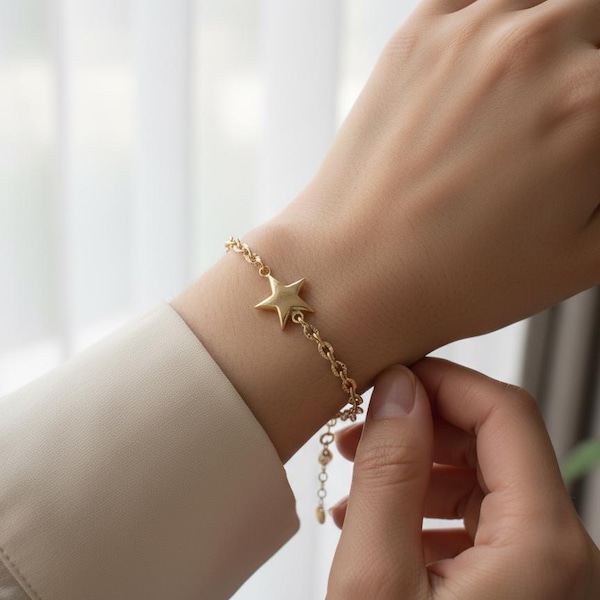 Star Bracelet
View Star Bracelet on Etsy
Children's wrists vary widely and grow fast, so a chart is only a starting point. Always measure the child's wrist, add a little ease, and choose an adjustable chain where possible so the bracelet lasts longer.
Babies should only wear bracelets under supervision, and never to sleep. Our baby gold bracelet guide covers sizing and safety in more detail, and our kids collection has engravable ID bracelets and small adjustable pieces.
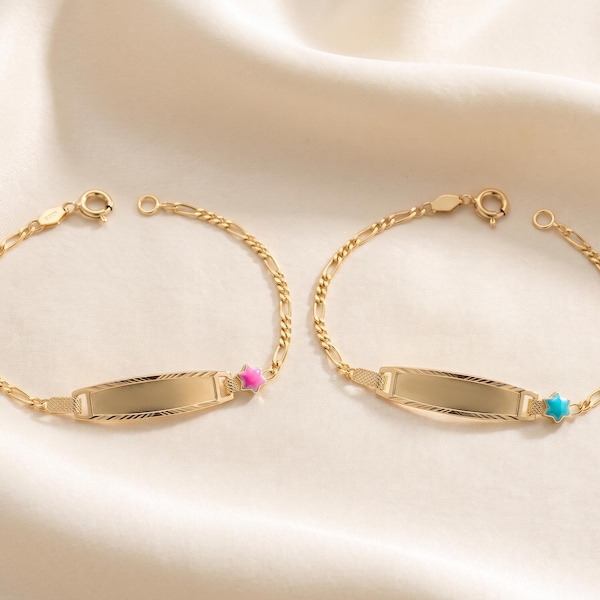 Baby ID Bracelet Engravable Name Plate with Pink or Turq…
View Baby ID Bracelet Engravable Name Plate with Pink or Turq… on Etsy
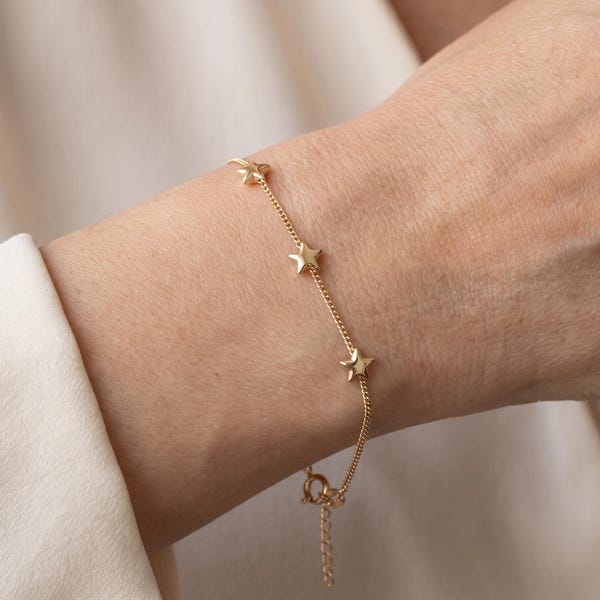 Three Star Bracelet
View Three Star Bracelet on Etsy
If you wear a bracelet next to a watch, a snug fit keeps it from sliding over the watch case and scratching it. For stacking several bracelets, mix fits: one snug, one comfort and one loose, so they sit at different points on the wrist instead of bunching together. The same spacing idea applies to necklaces, as we explain in how to layer necklaces.
Browse all bracelets to find your size.
For women, 18 cm (about 7 inches) is the most common bracelet length. Men's bracelets are usually longer, often around 20 to 22 cm.
Add about 1.5 cm for a snug fit, 2 cm for a comfortable fit and 2.5 cm for a loose fit. Add a little more for thick or chunky chains.
Wrap a strip of paper or string around your wrist, mark where it overlaps, then lay it flat and measure it with a ruler.
Choose the larger size for a chain bracelet, or pick an adjustable one. A slightly loose bracelet is more comfortable and puts less strain on the clasp.
Solid gold chain bracelets can usually be shortened or lengthened by a goldsmith. Message us before ordering to ask whether a different length is possible for a specific piece.
Share:
Can you swim with gold jewelry? What chlorine, salt water and sunscreen do to 14K gold, why rings get lost, and how to clean pieces after a swim.
How to fix a broken gold chain: spot a jump ring, clasp or link break, learn what is safe at home, why glue fails, and when a jeweler is the right ca…
How to untangle a gold chain without breaking it: the two-pin method, when to use oil or cornstarch, which chains knot most, and how to stop tangles…