Lost-Wax Casting Explained: How Gold Jewelry Is Cast, Step by Step
Lost-wax casting explained: how a wax model becomes a solid gold ring or pendant, from carving and investing to burnout, pouring and finishing at the…

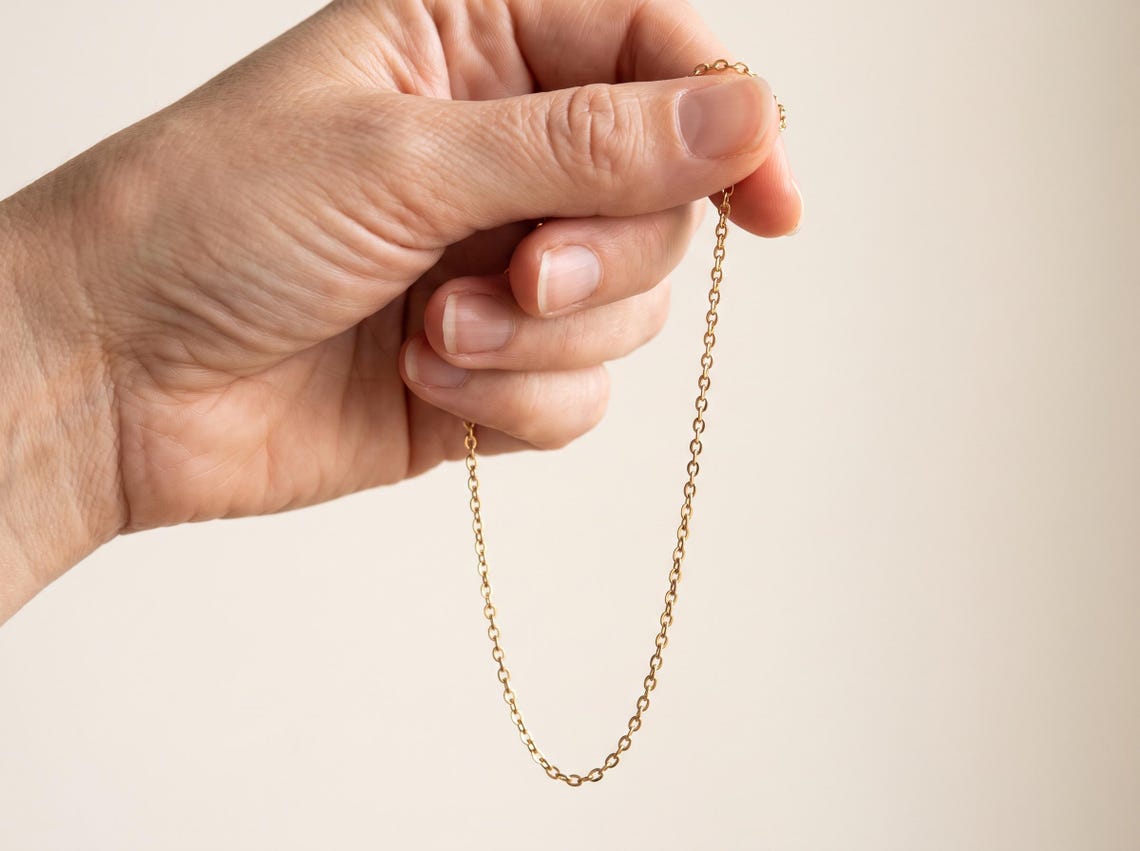
Gold chains are made by alloying gold, drawing it into fine wire, forming that wire into links, joining and soldering the links, and then shaping, cutting and polishing the chain into its final pattern. Today most chains are formed on specialized machines, while goldsmiths handle the alloy, the finishing, the clasps and any hand-built details.
A chain looks simple, but it is one of the most technical things in a jewelry workshop. Hundreds of tiny links have to be identical, strong and flexible at the same time. Here is how the process typically works.
Pure 24K gold is too soft for a chain that will be pulled, twisted and worn every day. So goldsmiths first make an alloy. For 14K gold, 58.5% pure gold is melted together with other metals such as silver, copper and zinc. The proportions of those other metals decide the color: more copper for rose gold, metals like palladium or nickel for white gold, a balanced mix for yellow gold. Our yellow, white and rose gold guide explains the differences.
The molten alloy is poured into a mold to make a bar or rod, ready to be worked.
The gold bar is passed through a rolling mill again and again, which squeezes it longer and thinner. Then it is pulled through a draw plate or wire-drawing machine: a series of hard dies with gradually smaller holes. Each pass makes the wire a little thinner and longer.
Metal becomes harder and more brittle as it is worked, so the wire is annealed (heated and cooled) between passes to keep it workable. The final wire diameter is one of the main factors that decide how strong and heavy a chain will be.
Next, the wire is turned into links. By hand, a goldsmith winds the wire tightly around a steel rod called a mandrel to make a coil, then saws the coil into individual rings. On a chain-making machine, the same thing happens automatically and at great speed: the machine bends, cuts and threads each new link through the previous one.
The shape of the mandrel and the way the links are threaded decide the chain style:
Our gold chain types guide covers how each one looks and wears.
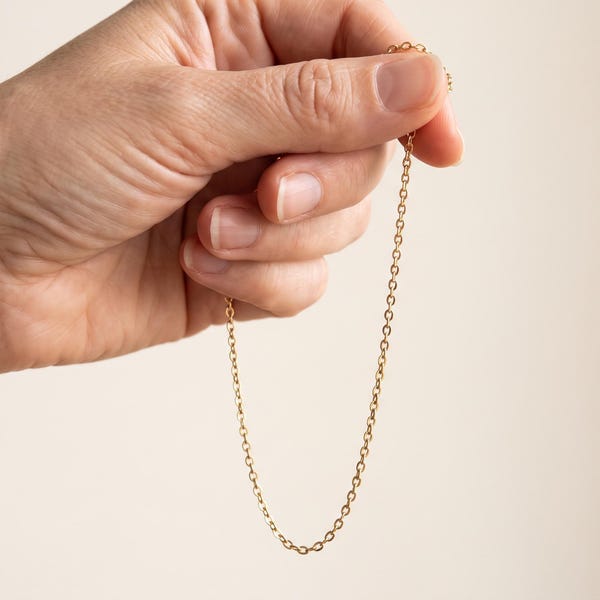 Cable Chain Necklace
View Cable Chain Necklace on Etsy
 Wheat Chain Necklace
View Wheat Chain Necklace on Etsy
An unsoldered link is just a bent piece of wire, and it can be pulled open. For strength, each link is closed with a tiny amount of gold solder or fused shut. In modern production this is often done by coating the chain with solder powder and passing it through a furnace, so every joint closes at once. By hand, a goldsmith solders link by link with a fine torch flame.
A well-soldered link is a solid ring of gold. This is a big part of why a good chain can be repaired rather than replaced if it breaks. See how to fix a broken gold chain.
Once soldered, many chains are shaped further:
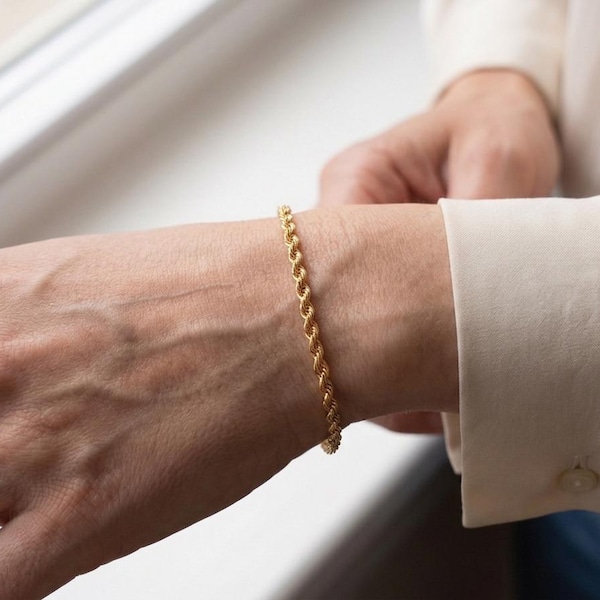 Rope Chain Bracelet
View Rope Chain Bracelet on Etsy
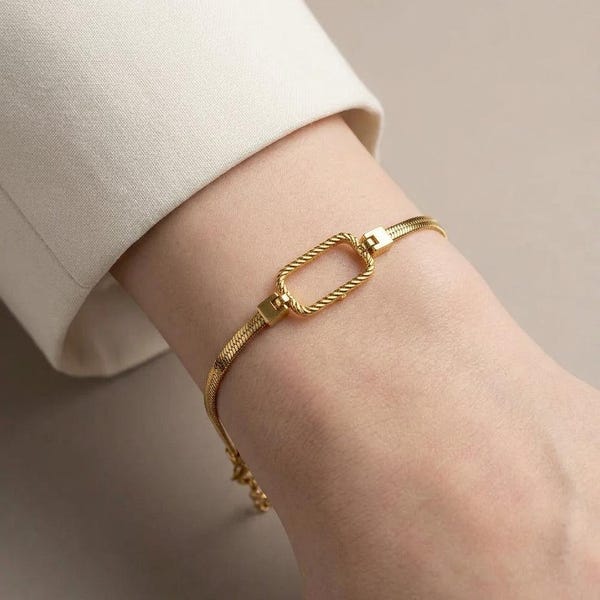 Herringbone Bracelet
View Herringbone Bracelet on Etsy
Some chains are faceted with a diamond-tipped cutting tool, which shaves tiny flat planes into the surface of the links. These facets catch light and sparkle. "Diamond-cut" describes this metal finish only; it does not mean the chain contains diamonds. Our guide to diamond-cut gold jewelry explains more.
The long chain is cut to the finished length, and end caps or end rings are soldered on. A clasp is attached, usually a lobster or spring ring on everyday chains (our jewelry clasp types guide explains each). Then the chain is cleaned and polished, often by tumbling with steel shot and then by hand, as described in how jewelry is polished. Finally, it is stamped with its karat mark, such as 585 for 14K.
| Hand-made | Machine-made | |
|---|---|---|
| How links are formed | Coiled on a mandrel and sawn by hand | Bent, cut and threaded automatically |
| Consistency | Slight variation, a handcrafted look | Very even links |
| Typical use | One-off or heavy, unusual designs | Most fine and everyday chains |
| Goldsmith's role | Every step | Alloy, inspection, finishing, clasps, repair |
Neither approach is automatically better. Machine-made chains are precise and strong when made from good wire and properly soldered. Hand-made chains bring character and are useful for designs a machine cannot produce.
You do not need a workshop to judge a chain. Lay it flat on a table and look closely:
Some chains are made from hollow tube instead of solid wire. Hollow chains look larger for their weight, but they dent more easily and are harder to repair. Every chain we sell is solid 14K gold; to understand the trade-off, read hollow vs solid gold jewelry. You can browse our chains and pendants in gold necklaces and our chain bracelets.
Most fine and everyday chains today are formed by machine, then finished, inspected and fitted with clasps by goldsmiths. Some heavier or unusual chains are still made link by link by hand.
Soldering closes each link into a solid ring so it cannot pull open under strain. Unsoldered links are much weaker and stretch more easily.
Wire thickness, link design, solid rather than hollow construction and well-soldered joints all add strength. A thicker solid curb or rope chain is usually stronger than a very fine cable chain.
No. Diamond-cut means the metal surface has been faceted with a diamond-tipped tool so it sparkles. No stones are involved.
Usually, yes. A goldsmith can solder a broken link or replace a damaged section, especially on solid chains. Hollow chains are harder to repair.
Share:
Lost-wax casting explained: how a wax model becomes a solid gold ring or pendant, from carving and investing to burnout, pouring and finishing at the…
What is a goldsmith? Learn what goldsmiths do, the tools and skills of the bench, how they differ from jewelers and silversmiths, and how it is learn…
Ottoman jewelry history: palace goldsmiths, the Topkapı treasury, favorite gems, tulip and rumi motifs, and how Ottoman style still shapes jewelry to…