
Turkish Gold Coin Traditions: Çeyrek, Yarım and Tam at Weddings and Births
Turkish gold coin traditions explained: what çeyrek, yarım and tam coins are, how they are pinned at weddings and births, and the customs behind the…


Ottoman jewelry was the goldwork and gem-setting of the Ottoman Empire, which lasted from around 1300 until 1922. It is known for gold set with large colored stones such as emeralds, rubies and turquoise, for court workshops of palace goldsmiths in Istanbul, and for floral and scrolling motifs like the tulip and the rumi that still appear in Turkish jewelry today.
As goldsmiths working in Istanbul's Grand Bazaar, a market founded in the Ottoman era, we live with this history every day. This article sticks to well-established facts and broad patterns, because Ottoman jewelry spans six centuries and a vast territory.
The Ottoman state began in northwest Anatolia around 1300. After Sultan Mehmed II conquered Constantinople in 1453, the city, later widely known as Istanbul, became the imperial capital. Soon afterwards, he ordered the building of a covered market at its center, the core of what became the Grand Bazaar. Goldsmiths and jewelers have worked there ever since. Our article on the history of Grand Bazaar goldsmiths tells that story in more detail.
Over the following centuries the empire reached into southeastern Europe, the Middle East and North Africa. Its jewelry absorbed influences from Byzantine, Persian, Arab and Balkan craft traditions, and later from European fashion.
The Ottoman court supported an organization of palace artisans known as the Ehl-i Hiref, roughly "the people of talent." Records from the 16th century list craftsmen in many specialties working for the palace, including goldsmiths, gem-setters, engravers and other metalworkers. They produced jewelry, ceremonial objects, weapons with jeweled hilts, and gifts for diplomacy.
Outside the palace, goldsmiths in Istanbul and other cities were organized in guilds, which regulated training, standards and trade. Skills were usually passed from master to apprentice, and often from parent to child, a pattern that continues in many family workshops today. If you are curious about the craft itself, see what is a goldsmith.
Topkapı Palace in Istanbul was the main residence of the sultans for centuries and has been a museum since the early Republic. Its Imperial Treasury holds some of the most famous Ottoman jeweled objects, including:
These pieces show the court's taste for bold stones and dense, rich ornament.
| Material | How it was used | Notes |
|---|---|---|
| Gold | Settings, filigree, belts, buckles, ornaments | The base of most court jewelry |
| Emeralds | Large cabochons and carved stones, dagger hilts, pendants | A favored color at court |
| Rubies and spinels | Set in gold on ornaments and objects | Rich reds paired with green and gold |
| Turquoise | Inlaid in gold and on objects | The English name comes from French for "Turkish stone" |
| Pearls | Strings, fringes, headpieces | Often combined with colored stones |
| Diamonds | Increasingly popular in later centuries | Common in 19th-century pieces |
Many earlier Ottoman stones were polished as smooth cabochons or table cuts rather than the many-faceted cuts common today, which gives the pieces a soft, glowing color. Our guides to turquoise jewelry and gemstone meanings look at these stones in modern jewelry.
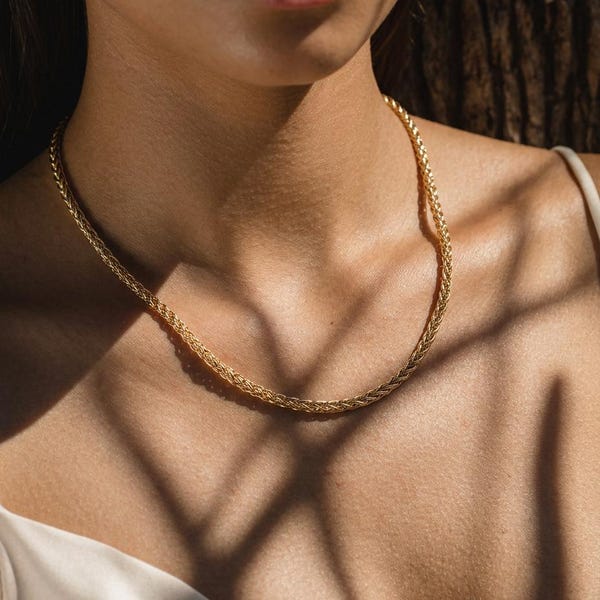
 Turquoise Station Necklace
View Turquoise Station Necklace on Etsy
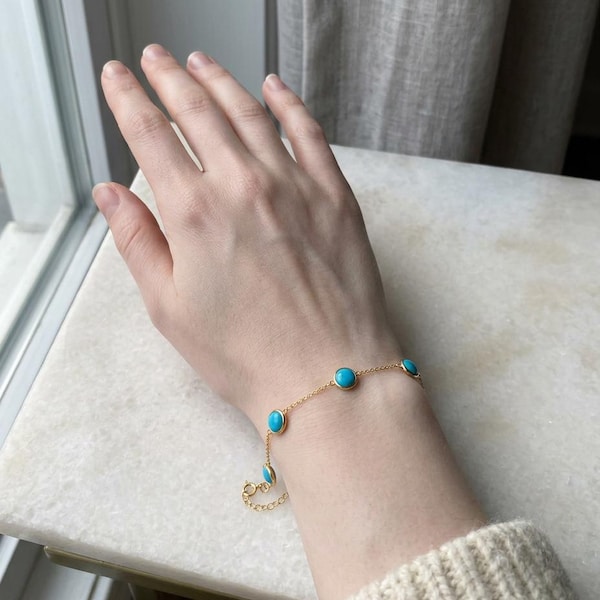 Turquoise Station Bracelet
View Turquoise Station Bracelet on Etsy
The tulip was one of the most loved flowers in Ottoman art, appearing on tiles, textiles and jewelry. The early 18th century is even known as the Tulip Era (Lale Devri) for the period's passion for the flower.
Rumi designs are stylized, split-leaf scrolls, while hatayi designs are stylized flowers and blossoms. Both appear widely in Ottoman decorative arts, including engraved and pierced goldwork.
Carnations, hyacinths and long serrated leaves, often called the saz style, became characteristic of 16th-century court design.
The crescent and star became closely associated with the Ottoman state and remain on the Turkish flag today. Read more in our article on the crescent moon and star meaning.
Court treasures are only part of the picture. Across the empire, women in towns and villages wore jewelry that marked marriage, family wealth and regional identity. Common pieces included large decorative belt buckles, headpieces and forehead ornaments, earrings, bracelets and necklaces strung with gold coins. Materials ranged from gold to silver depending on the family and region, and designs differed from one area to the next. Many of these customs, such as giving gold at weddings, live on today; see Turkish gold coin traditions.
In the 19th century, as the empire opened to European influence, jewelry changed with it. Brooches, tiaras and diamond-set floral sprays in European styles became fashionable at court and among wealthy families, while regional traditions continued across Anatolia and the Balkans.
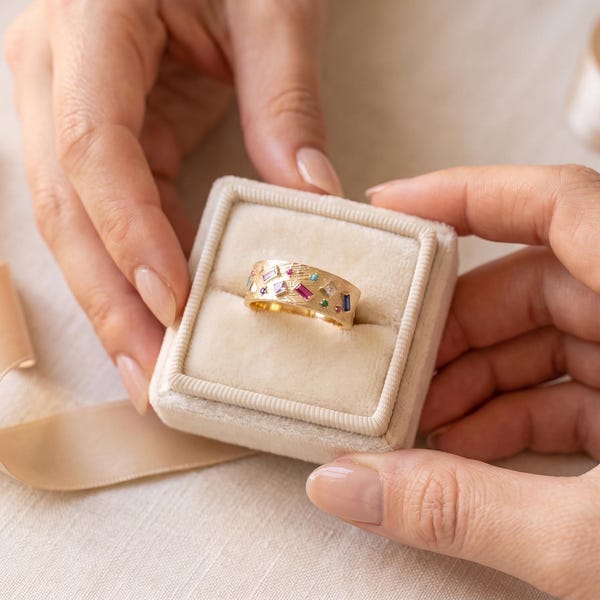
Today, "Ottoman style" usually means bold gold with colored stones, textured or engraved surfaces and floral motifs. Modern pieces borrow these ideas while being made for everyday wear. Our chunky textured ring with scattered multicolored stones is one example of a modern design that nods to that look.
Its stones are described on the listing; like most of our colored pieces, they are not presented as natural emeralds or rubies. You can explore related customs in Turkish jewelry traditions and Anatolian jewelry motifs, or browse our gold rings.
It is known for gold set with large colored stones such as emeralds, rubies and turquoise, for pearls, and for floral and scrolling motifs like the tulip, rumi and hatayi.
The Imperial Treasury at Topkapı Palace in Istanbul holds some of the most famous Ottoman jeweled objects, including the Topkapı Dagger and the Spoonmaker's Diamond. Other museums in Turkey and abroad also hold Ottoman pieces.
Palace artisans organized as the Ehl-i Hiref, including goldsmiths and gem-setters, made jewelry and objects for the court, alongside guild craftsmen in the city.
Yes. Its core was built on the orders of Sultan Mehmed II in the years after the 1453 conquest, and it grew over the following centuries.
The word turquoise comes from the French for "Turkish stone," because the gem reached Europe through Ottoman trade routes. It has long been popular in Turkish jewelry.
Share:
Turkish gold coin traditions explained: what çeyrek, yarım and tam coins are, how they are pinned at weddings and births, and the customs behind the…
The history of Grand Bazaar goldsmiths, from Mehmed II's Old Bedesten after 1453 to the jewelers' streets of Kuyumcular Çarşısı, told by bazaar golds…
How gold jewelry is made, explained by Grand Bazaar goldsmiths: alloying, casting, chain making, soldering, stone setting, polishing and the 585 hall…