How Gold Chains Are Made: From Gold Wire to Finished Necklace
How gold chains are made: alloying, drawing wire, forming and soldering links, shaping rope, wheat and curb patterns, then diamond-cutting and polish…

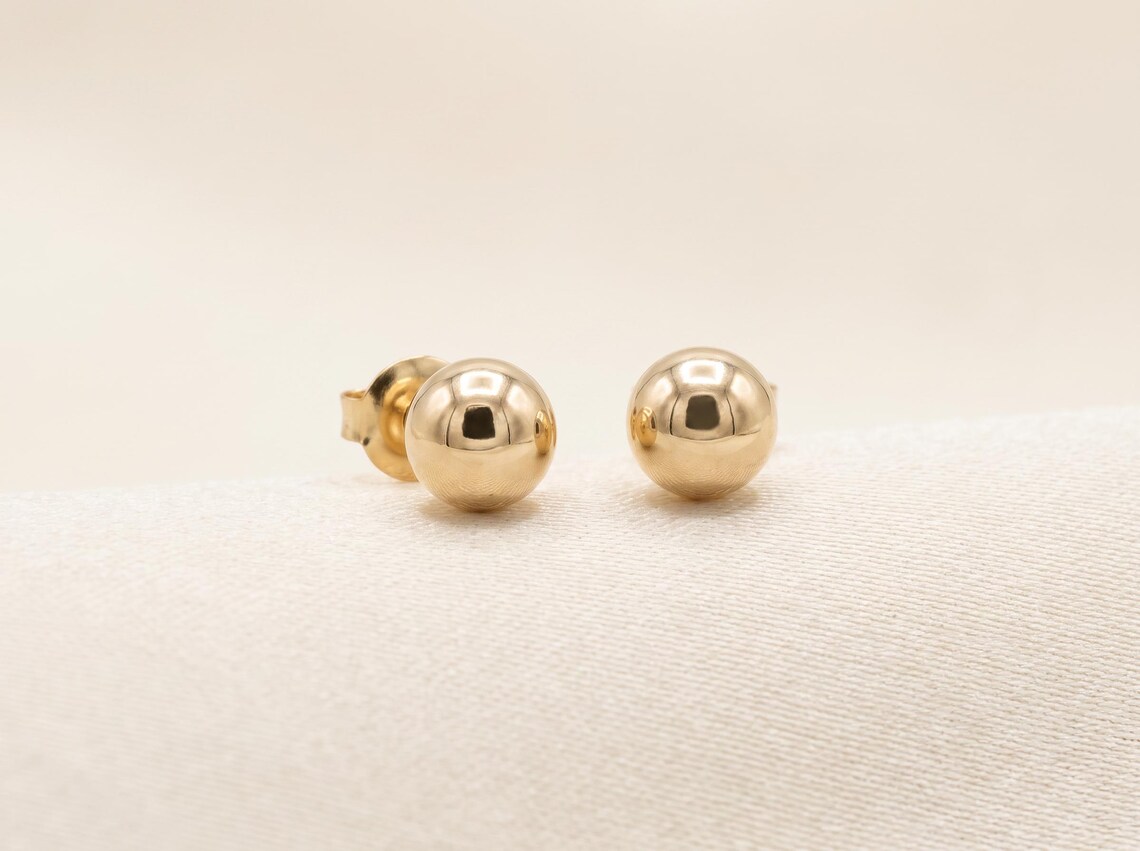
Jewelry is polished in stages: a goldsmith first files and sands away tool marks, then uses spinning wheels charged with progressively finer polishing compounds, usually a cutting compound like tripoli followed by a fine compound like rouge, and finally cleans the piece in warm soapy water or an ultrasonic bath. The result is a smooth, mirror-bright surface, or a deliberately textured one if the design calls for it.
Polishing is often the last step before a piece is stamped and packed, and it can take as long as making the piece. Here is how goldsmiths typically do it, and what it means for the jewelry you wear.
Every stage of making a piece leaves marks. Casting leaves a slightly rough skin, saws leave lines, files leave scratches and solder can leave small blemishes. Polishing removes all of that, and it does more than make a piece shine:
Before any wheel touches the piece, the goldsmith shapes and refines it by hand. Fine files remove sprue stubs and excess solder. Then come abrasive papers or rubber wheels in increasingly fine grits, each one removing the scratches left by the last.
This is the step that decides the final quality. Polishing compounds cannot fix a deep scratch, a wavy surface or a lumpy solder joint. If the sanding is careful, the polish will be flawless; if it is rushed, every flaw shows under a bright finish.
Next, the piece goes to the polishing motor, a machine that spins cloth, felt or bristle wheels at high speed. The wheel is loaded with a polishing compound: a bar of fine abrasive bound in wax.
The first compound is a cutting or pre-polish compound. Tripoli, a traditional choice, is mildly abrasive and removes fine sanding lines. Small brushes and felt cones reach inside rings, between links and around settings.
After cleaning off the first compound, the goldsmith switches to a clean wheel and a very fine compound. Rouge, a red iron oxide compound, is the classic final polish for gold and gives a deep, mirror-like shine. Many workshops also use modern compounds designed for specific metals.
Wheels and compounds are kept strictly separate. A trace of coarse compound on a final-polish wheel will scratch the very surface you are trying to perfect.
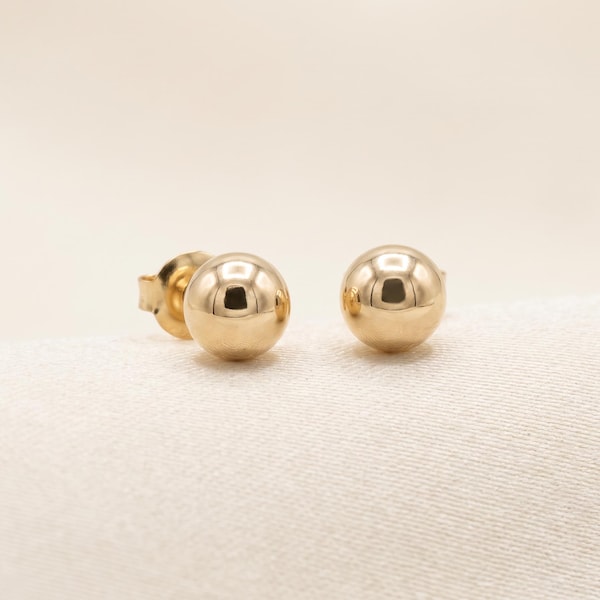 Ball Stud Earrings
View Ball Stud Earrings on Etsy
 Cross Necklace Gold 14K Solid
View Cross Necklace Gold 14K Solid on Etsy
Some pieces, especially chains, are finished in a tumbler: a rotating or vibrating barrel filled with small steel shapes (steel shot), water and a burnishing soap. As the barrel moves, the steel rubs against the gold, smoothing and brightening it and work-hardening the surface a little. Tumbling is gentle enough for chains that would catch on a fast wheel.
Magnetic finishers, which spin tiny steel pins around the piece, are another option for reaching small crevices.
Polishing compounds leave a greasy residue, especially in crevices and behind stones. Pieces are washed in warm soapy water, often in an ultrasonic cleaner that uses high-frequency vibrations to shake residue loose, and then rinsed and dried. Some workshops use a steam cleaner for a final blast.
Not every stone or material is ultrasonic-safe; pearls, enamel and some natural stones are cleaned by hand.
Polishing is not only about high shine. Goldsmiths create different surfaces on purpose:
| Finish | How it is made | Look | Wear |
|---|---|---|---|
| High polish | Sanding, then tripoli and rouge on wheels | Mirror-bright | Shows fine scratches over time; easy to re-polish |
| Satin or brushed | Fine abrasive brush or pad drawn in one direction | Soft sheen with fine lines | Hides small scratches well |
| Matte or sandblasted | Fine abrasive blasted at the surface | Flat, velvety | Can polish up in high-contact spots |
| Hammered | Shaped hammer marks before polishing | Rippled, light-catching | Very forgiving |
| Diamond-cut | Facets cut into metal with a diamond-tipped tool | Sparkling, faceted | Facets can soften slightly with long wear |
Many pieces combine finishes, such as a polished outline with a textured center, or a textured band beside a polished one. Our guide to diamond-cut gold jewelry explains that finish in more detail.
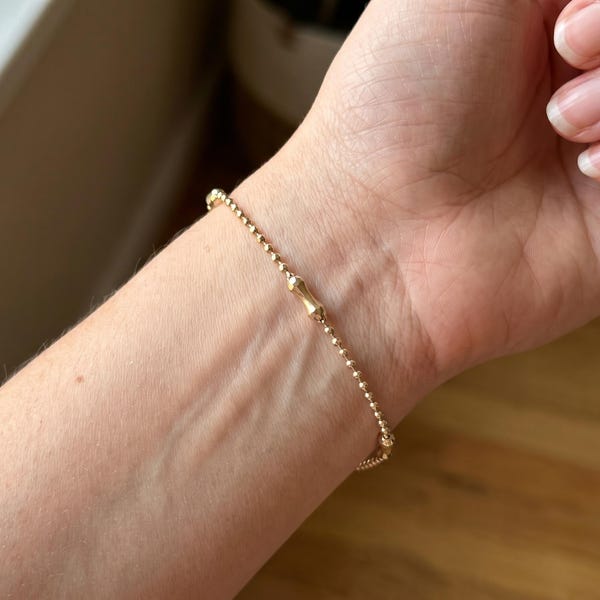 Diamond-Cut Ball Chain Bracelet
View Diamond-Cut Ball Chain Bracelet on Etsy
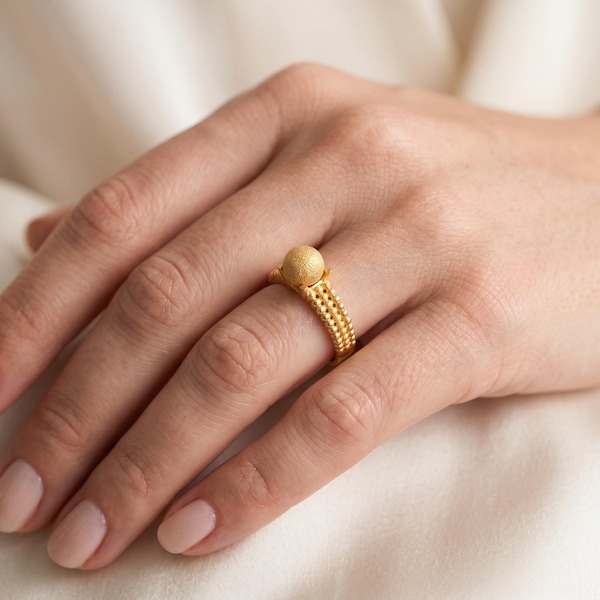 Chunky Gold Ring
View Chunky Gold Ring on Etsy
At home, a soft polishing cloth is the right tool. It removes light tarnish and fingerprints and brings back shine without removing metal. Our guide on how to polish gold jewelry covers safe home methods, and how to clean gold jewelry at home explains the soap-and-water routine.
Professional polishing on a wheel removes a microscopic layer of metal to erase scratches. That is fine now and then, but it should not be done constantly, because each polish takes a tiny amount of gold away. For most people, a professional polish every year or two on heavily worn rings is plenty. Our jewelry maintenance checklist suggests a sensible rhythm.
Solid gold has the same metal all the way through, so polishing reveals more gold. Plated jewelry has only a thin surface layer of gold, and aggressive polishing can wear straight through it. Our pieces are solid 14K gold, stamped 585, so a scratched surface can be brought back to a bright finish. Read more in solid gold vs gold-filled vs gold-plated and does gold jewelry scratch.
Browse polished and textured pieces in our gold rings and gold earrings.
Goldsmiths typically use a polishing motor with cloth and felt wheels, a cutting compound such as tripoli and a fine compound such as rouge, plus tumblers and ultrasonic cleaners for finishing.
Professional wheel polishing removes a microscopic layer of metal to erase scratches. Occasional polishing is harmless, but very frequent polishing slowly thins a piece.
For rings and bracelets worn every day, once every year or two is usually enough. Between polishes, a soft polishing cloth keeps the shine.
Yes. A goldsmith can re-create satin, brushed or matte finishes with the right abrasives, and can also turn a matte piece high-polish if you prefer.
A soft cloth is generally safe for gold with CZ and most hard stones. Pearls, enamel and softer natural stones should be wiped gently and kept away from abrasive cloths.
Share:
How gold chains are made: alloying, drawing wire, forming and soldering links, shaping rope, wheat and curb patterns, then diamond-cutting and polish…
Lost-wax casting explained: how a wax model becomes a solid gold ring or pendant, from carving and investing to burnout, pouring and finishing at the…
What is a goldsmith? Learn what goldsmiths do, the tools and skills of the bench, how they differ from jewelers and silversmiths, and how it is learn…