Does Perfume Damage Gold Jewelry? What Really Happens to 14K Gold
Does perfume damage gold jewelry? Solid 14K gold holds up, but perfume dulls shine and harms pearls and some stones. Learn the safe order and simple…


Yes, gold jewelry can scratch, because gold is a relatively soft metal. 14K gold is much more scratch-resistant than 18K, 22K or 24K gold because the added alloy metals make it harder, but everyday pieces, especially rings and bracelets, will still pick up fine marks over time.
That is normal, and it is not a sign of poor quality. Here we explain why gold scratches, how karat and finish change the picture, how to prevent most marks and what to do when a favorite piece starts to look worn.
Pure gold is one of the softest metals used in jewelry. You can mark 24K gold with a fingernail. To make gold practical for jewelry, goldsmiths mix it with harder metals such as copper, silver and zinc. The result is an alloy that holds its shape and resists wear far better than pure gold.
Even so, many ordinary things are harder than gold alloys:
Each contact leaves a tiny mark. Over months, hundreds of them blend into a soft, satin-like surface sometimes called a patina.
Higher karat means more pure gold and a softer metal. Lower karat means more alloy metal and a harder, more durable piece.
| Karat | Pure gold content | Scratch resistance | Best for |
|---|---|---|---|
| 24K | 99.9% | Very low | Coins, ceremonial pieces |
| 22K | 91.6% | Low | Traditional jewelry worn with care |
| 18K | 75% | Moderate | Fine jewelry, occasional to regular wear |
| 14K | 58.5% | Good | Everyday rings, chains, bracelets |
| 10K | 41.7% | Higher | Budget-focused, hard-wearing pieces |
14K sits in a practical middle: rich gold color with good everyday durability, which is why every piece we make is solid 14K gold, stamped 585. For a full comparison see our gold karat chart, 14K vs 18K gold and 10K vs 14K gold.
How a piece is worn matters more than anything else.
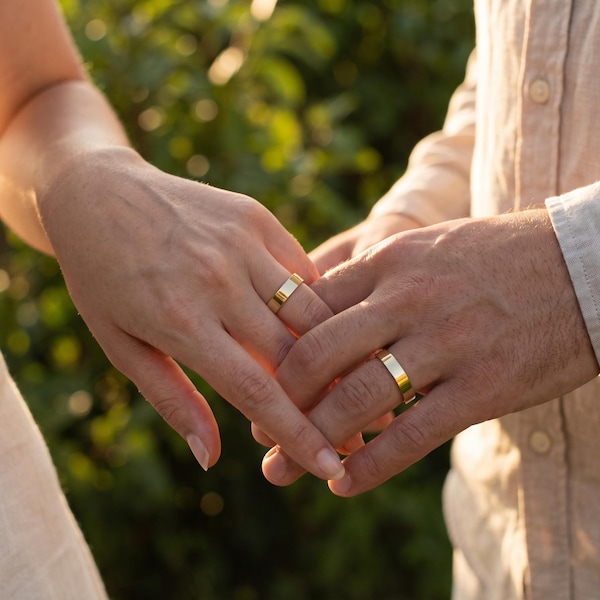 Flat Wedding Band Polished Ring for Him and Her
View Flat Wedding Band Polished Ring for Him and Her on Etsy
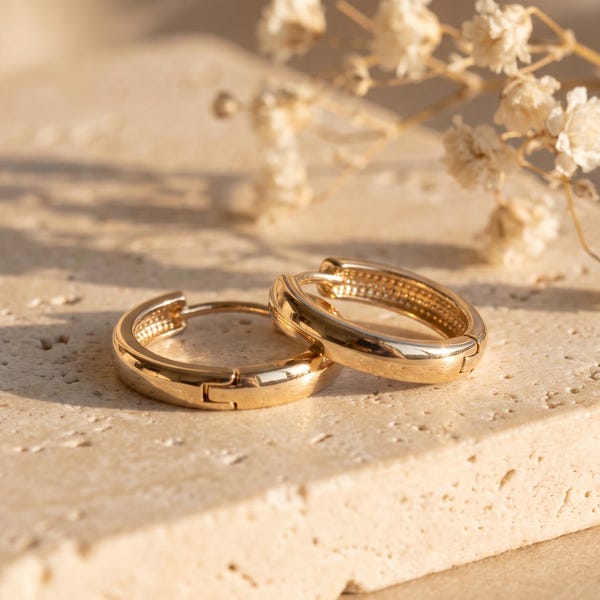 Huggie Hoop Earrings Thick Domed Band
View Huggie Hoop Earrings Thick Domed Band on Etsy
A flat polished wedding band and thick domed huggies show scratches more clearly than textured designs because their smooth surfaces reflect light evenly.
The surface finish makes a big difference to how visible scratches are.
A mirror finish looks bright but shows fine scratches most easily. It is also the easiest to restore with polishing.
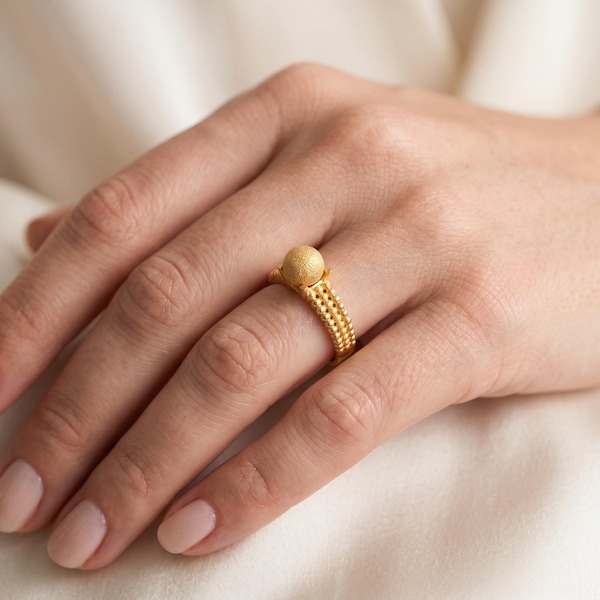
Raised textures, beads and hammered surfaces break up light, so small scratches blend in. These are good choices for people who are hard on jewelry.
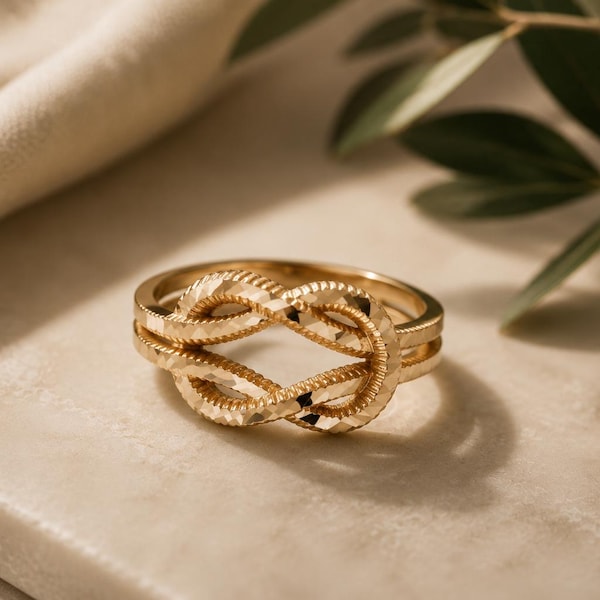
Faceted cuts in the metal sparkle and hide light wear well, though deep knocks can soften the facet edges. Our guide to diamond-cut gold jewelry explains the technique.
A brushed finish already has fine lines, so new scratches are less noticeable, although heavy marks can turn it shiny in patches.
Our chunky textured mesh ring and diamond-cut love knot ring are both good options if you want a ring that keeps looking good with daily wear.
A scratch on solid gold is still gold underneath, so it only changes the surface texture. On plated jewelry, a deep scratch can cut through the thin gold layer and reveal the base metal, which may look silver, gray or coppery and cannot be polished away. This is one of the main practical differences explained in solid vs filled vs plated gold.
It also means solid gold can be refinished many times over its life. A polished, refreshed solid gold ring can look close to new decades after it was made.
Some people prefer to leave the patina alone. A softly worn wedding band tells the story of years of wear, and many find that more personal than a fresh shine.
No. All gold scratches, including fine jewelry from the most respected makers. What separates good craftsmanship is how the piece holds up structurally: secure stones, strong solder joints and a clasp that stays closed. Surface scratches are cosmetic. Our pieces come with a lifetime guarantee on craftsmanship, and Şerif answers any questions personally if something does not look right. Browse hard-wearing textured styles in our ring collection.
14K gold is harder than 18K or 22K gold and resists scratches well for everyday wear, but it will still pick up fine marks over time, especially on rings.
Yes. Light haze can be polished with a cloth at home, and deeper scratches can be polished out by a goldsmith.
Textured, hammered, brushed and diamond-cut finishes hide scratches better than a smooth high polish.
No. Solid gold is the same all the way through, so a scratch only affects the surface. Plated jewelry can show base metal when scratched.
Stacked rings will rub and show some wear, which many people accept as part of the look. Keep stone-set rings away from soft plain bands if you want to limit scratches.
Share:
Does perfume damage gold jewelry? Solid 14K gold holds up, but perfume dulls shine and harms pearls and some stones. Learn the safe order and simple…
How to clean cubic zirconia jewelry at home: a gentle soap-and-brush method, what makes CZ cloudy, what to avoid, and how to keep pave settings secur…
Can gold rings be resized? Solid gold rings usually can, within limits. Learn how resizing works, why eternity and pave rings are harder, and how to…